10 Branding Solutions for Sales and Marketing Messaging

10 Branding Solutions for Sales and Marketing Messaging
When your sales rep pitches one version of your product and your marketing materials tell a different story, buyers notice. Research from Gartner shows that B2B buyers are 1.8 times more likely to complete a high-quality deal when digital tools work in partnership with sales representatives. That coordination starts with consistent branding solutions.
This article covers ten practical branding solutions that keep your sales and marketing messaging aligned across every touchpoint. Hunt + Hawk delivers these exact frameworks to help B2B SaaS and professional services firms speak with one voice—from first website visit to signed contract.
You’ll find messaging frameworks, brand playbooks, and go-to-market assets that your teams can deploy immediately. Each solution tackles a specific alignment challenge with clear implementation steps.
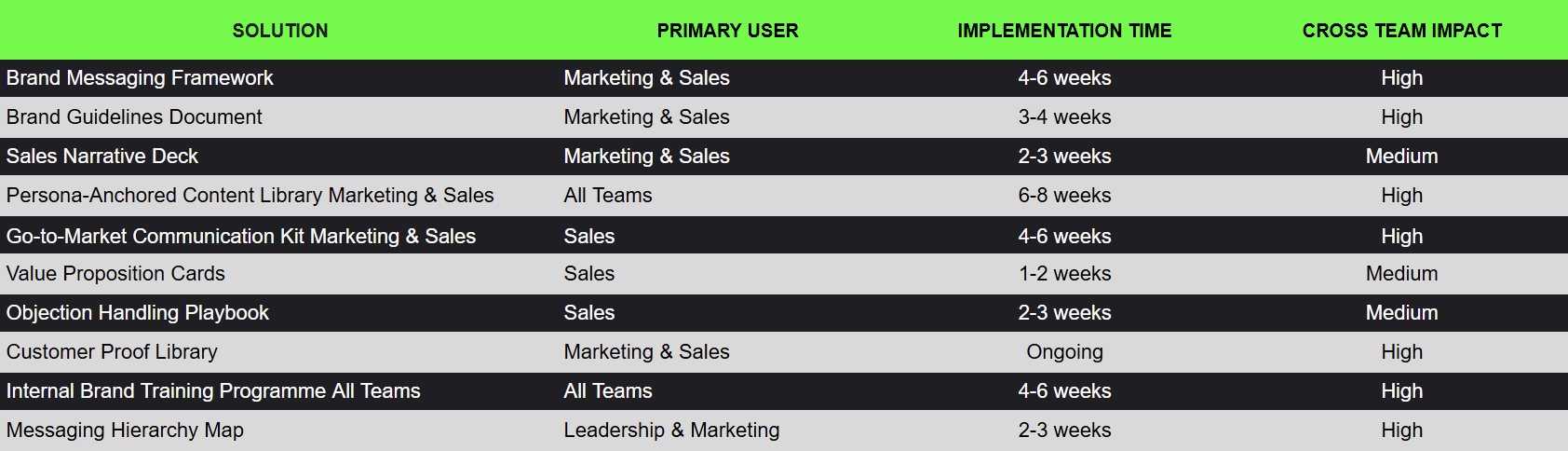
- Brand Messaging Framework: Your single source of truth for positioning, value props, and audience-specific language
- Brand Guidelines Document: Visual and verbal standards that ensure recognition across all channels
- Sales Narrative Deck: A storyline structure that moves prospects from problem to solution
- Persona-Anchored Content Library: Targeted materials mapped to each buyer’s specific concerns
- Go-to-Market Communication Kit: Launch-ready assets for coordinated product and service rollouts
- Value Proposition Cards: Quick-reference guides connecting features to buyer outcomes
- Objection Handling Playbook: Scripted responses that address common buyer concerns with brand-aligned language
- Customer Proof Library: Case studies and testimonials organised by industry and use case
- Internal Brand Training Programme: Onboarding materials that get new hires brand-ready faster
- Messaging Hierarchy Map: A tiered structure showing how messages cascade from corporate to product level
1. Brand Messaging Framework: Your single source of truth
A brand messaging framework captures everything your team needs to describe your business consistently. It connects your market position to customer pain points, then links those to specific value statements and proof points. When marketing writes a campaign and sales delivers a pitch, both draw from the same well.
Hunt + Hawk builds messaging frameworks that become daily working documents, not deck decorations gathering digital dust. The goal is language your team reaches for instinctively—because it works.
Without this foundation, every department invents its own version of your story. Marketing writes website copy that promises broad benefits. Sales ignores it and creates their own pitch. Product describes features in technical language nobody else uses. Your buyers experience that inconsistency as confusion, and confused buyers don’t buy.
Brand Messaging Framework benefits
- Core positioning clarity: Defines what you are, who you serve, and why you matter—in language everyone understands
- Pain point mapping: Documents the exact problems your buyers face, so your team speaks to real concerns
- Value pillar structure: Organises your key differentiators into memorable, repeatable themes
- Proof point repository: Connects each claim to evidence that makes it believable
- Persona adaptation: Shows how messaging shifts for different audiences and buying roles
- Objection responses: Gives your team ready answers for common pushback
Brand Messaging Framework pros and cons
Pros:
- Creates alignment that reduces wasted effort on conflicting materials
- Speeds up content creation by giving writers a strong starting point
- Improves win rates by sharpening your differentiation
Cons:
- Requires upfront research investment, though this pays back quickly through faster execution
- Needs periodic updates as your market evolves, which keeps the document relevant
- Initial stakeholder alignment takes time, though this prevents larger conflicts later
2. Brand Guidelines Document: Visual and verbal standards
Brand guidelines go beyond logo files and colour codes. A useful guidelines document answers the practical questions your team asks daily: “What tone should I use for this email?” “Can I use the logo this way?” “How do I describe what we do in one sentence?”
When someone sees your content—a social post, an email, a presentation—they should recognise it as yours immediately. Consistent voice, visual style, and messaging create that recognition over time.
Brand Guidelines benefits
- Visual consistency: Ensures every piece looks like it came from the same company
- Voice and tone direction: Guides how you sound across different contexts
- Usage rules: Prevents common mistakes before they happen
Brand Guidelines pros and cons
Pros:
- Enables anyone to create on-brand content without constant approvals
- Builds brand equity through repeated, consistent exposure
- Reduces creative debates by establishing clear standards
Cons:
- Overly rigid guidelines can limit creativity, so balance structure with flexibility
- Needs buy-in from leadership to be enforced consistently
- Requires accessible storage so people can find and use it
3. Sales Narrative Deck: A storyline that converts
A sales narrative deck structures your pitch as a story with a beginning, middle, and end. It opens with the prospect’s world and challenges, introduces your solution as the path forward, and closes with a clear vision of success.
This differs from a standard pitch deck that lists features and benefits. The narrative approach keeps prospects engaged because they see themselves in the story.
Sales Narrative Deck benefits
- Engagement structure: Keeps prospects listening rather than checking their phones
- Problem-solution flow: Connects your offering to their specific challenges
- Modular sections: Allows reps to customise without losing the core message
Sales Narrative Deck pros and cons
Pros:
- Creates memorable presentations that differentiate you from competitors
- Gives new salespeople a proven structure to follow
- Aligns what sales says with what marketing promises
Cons:
- Requires reps to learn a new approach, which takes practice
- May need customisation for different industries or use cases
- Works better for considered purchases than transactional sales
4. Persona-Anchored Content Library: Materials for every buyer
Different stakeholders in a buying decision seek different information. Your CFO cares about ROI and risk. Your IT Director cares about integration and security. Your end users care about daily workflow impact.
A persona-anchored content library organises your materials by who needs them, not by what format they take. Each piece speaks directly to that person’s concerns.
Persona-Anchored Content benefits
- Targeted relevance: Speaks to each stakeholder’s specific priorities
- Sales efficiency: Reps find the right asset quickly during deals
- Buyer enablement: Helps champions sell internally to their colleagues
Persona-Anchored Content pros and cons
Pros:
- Increases content engagement by matching message to audience
- Supports multi-stakeholder deals common in B2B purchases
- Makes content gaps visible so you can fill them strategically
Cons:
- Requires detailed persona research to get right
- Creates more assets to maintain and update
- Needs clear organisation or it becomes another content dump
5. Go-to-Market Communication Kit: Launch coordination
Product launches fail when marketing announces one thing and sales isn’t ready to talk about it. A go-to-market kit bundles everything both teams need for a coordinated launch: messaging documents, sales enablement materials, customer-facing content, and internal training resources.
Hunt + Hawk creates GTM kits that turn launches into revenue events rather than awareness exercises.
Go-to-Market Kit benefits
- Launch readiness: Ensures everyone has what they need before you go live
- Message consistency: Coordinates what you say across all channels
- Sales preparedness: Gives reps confidence to pitch new offerings immediately
Go-to-Market Kit pros and cons
Pros:
- Accelerates time-to-revenue on new product introductions
- Reduces the “marketing says one thing, sales says another” problem
- Creates reusable templates for future launches
Cons:
- Requires cross-functional coordination to assemble
- Needs updating if the product or positioning evolves post-launch
- Takes advance planning—difficult to create after the fact
6. Value Proposition Cards: Quick-reference guides
Value proposition cards distil your key differentiators into portable, memorable formats. Each card focuses on one value theme and connects features to specific buyer outcomes.
Your sales team can reference these during calls, share them with prospects, or use them to prepare for meetings. Marketing uses the same cards to maintain consistency in campaigns.
Value Proposition Cards benefits
- Portability: Easy to reference, share, and remember
- Feature-to-benefit translation: Turns technical specs into buyer language
- Consistency tool: Keeps everyone speaking the same value language
Value Proposition Cards pros and cons
Pros:
- Simple to create and distribute across your organisation
- Immediately usable with minimal training
- Easy to update as your offering evolves
Cons:
- Requires discipline to keep concise—the temptation is to add everything
- Works better as a complement to deeper materials than a standalone
- May need different versions for different markets or products
7. Objection Handling Playbook: Ready responses
Every sales team hears the same objections repeatedly: “Your solution costs too much.” “We’re happy with our current provider.” “We don’t have time to implement this right now.”
An objection handling playbook documents each common objection along with brand-aligned responses that acknowledge the concern, reframe the conversation, and move toward resolution.
Objection Handling Playbook benefits
- Confidence builder: Reps know what to say when tough questions come up
- Message consistency: Everyone handles objections the same way
- Training accelerator: New hires learn proven responses faster
Objection Handling Playbook pros and cons
Pros:
- Reduces lost deals from poorly handled objections
- Captures institutional knowledge from top performers
- Creates opportunities for continuous improvement as new objections emerge
Cons:
- Responses can sound scripted if reps don’t personalise them
- Needs regular updates as market conditions change
- Requires input from sales to capture real-world objections
8. Customer Proof Library: Evidence that convinces
Buyers trust other buyers more than they trust your marketing. A customer proof library organises case studies, testimonials, reviews, and success metrics by industry, company size, and use case—making it easy to match proof to prospect.
When a SaaS company asks for relevant examples, you can show them three case studies from their exact sector within minutes.
Customer Proof Library benefits
- Credibility on demand: Match proof points to specific prospect concerns
- Sales enablement: Give reps the evidence they need to close deals
- Marketing content: Feed campaigns with real customer stories
Customer Proof Library pros and cons
Pros:
- Builds trust faster than any amount of self-promotion
- Supports multiple use cases from a single customer relationship
- Creates competitive differentiation through real results
Cons:
- Requires ongoing customer relationship management to gather stories
- Some customers prefer privacy, limiting available proof points
- Needs organisation and maintenance to stay useful
9. Internal Brand Training Programme: Get everyone aligned
Your newest hire should be able to describe your company as clearly as your CEO. An internal brand training programme brings new team members up to speed on positioning, messaging, voice, and values—so they represent your brand correctly from day one.
This applies beyond sales and marketing. Customer success, support, and even operations teams interact with customers and need the same foundation.
Internal Brand Training benefits
- Faster onboarding: New hires become brand ambassadors sooner
- Consistent experience: Every touchpoint reinforces the same message
- Cultural alignment: Connects brand values to daily behaviour
Internal Brand Training pros and cons
Pros:
- Reduces the time it takes for new employees to become effective
- Prevents brand drift as your team grows
- Creates shared vocabulary across departments
Cons:
- Takes time to develop meaningful training materials
- Needs reinforcement over time, not just a one-time session
- Requires updates when brand elements evolve
10. Messaging Hierarchy Map: Corporate to product alignment
A messaging hierarchy map shows how your corporate-level story connects to business unit messages, product positioning, and feature-level claims. It creates a logical cascade so everything fits together.
When you add a new product or enter a new market, this map shows exactly where new messaging fits and how it relates to your broader brand story.
Messaging Hierarchy Map benefits
- Strategic clarity: Shows how all your messages connect and support each other
- Expansion guidance: Makes it easier to add new products or markets
- Portfolio coherence: Prevents individual products from fragmenting your brand
Messaging Hierarchy Map pros and cons
Pros:
- Prevents messaging conflicts as your company grows
- Clarifies relationships between different parts of your business
- Guides brand architecture decisions
Cons:
- Can become complex for companies with many products or services
- Requires cross-functional agreement on hierarchy relationships
- Needs revision as your portfolio evolves
You’ll know these branding solutions are working when specific metrics improve. Start tracking these indicators before you implement changes so you can measure progress.
- Message consistency audits: Compare what marketing publishes with what sales says in calls. Look for contradictions or gaps.
- Sales cycle length: Aligned messaging typically shortens the time from first touch to closed deal.
- Lead-to-close rate: When prospects receive consistent information, more of them convert.
- Content usage rates: Track which sales enablement materials actually get used. Unused content signals misalignment.
- Buyer feedback: Ask won and lost prospects about their experience with your messaging.
Understanding why misalignment happens helps you prevent it. These patterns appear in organisations of all sizes.
- Different definitions: Marketing and sales often mean different things by the same words. “Qualified lead” is the classic example.
- Separate goals: When marketing chases MQLs and sales chases revenue, their incentives pull in different directions.
- Information gaps: Sales hears objections that never reach marketing. Marketing creates assets that sales never sees.
- Time pressure: When sales needs a solution now, they create their own materials. Those improvised pieces drift from brand standards.
- Tool silos: Different systems prevent data sharing that would reveal misalignment earlier.
Hunt + Hawk combines brand strategy expertise with real sales experience—an unusual pairing that makes all the difference. When we build your messaging framework, we stress-test it against the conversations your sales team has every day. When we create sales enablement materials, we ground them in proven brand strategy.
Our team includes senior brand strategists, copywriters, designers, and marketing technologists who work together on every engagement. Hunt + Hawk creates integrated branding solutions where every piece reinforces the others.
We’ve helped B2B SaaS companies and professional services firms align their sales and marketing messaging across industries including technology, finance, and healthcare. Each engagement starts with understanding your specific alignment challenges and ends with working tools your team will use.
Ready to stop the disconnect between what marketing promises and what sales delivers? Contact Hunt + Hawk to discuss which branding solutions will close the gaps in your organisation.
FAQs About Brand Identity for B2B SaaS
What is a brand messaging framework?
A brand messaging framework is a document that defines how you talk about your product or service to different audiences. It includes your core positioning, value propositions, proof points, and persona-specific language. Hunt + Hawk builds messaging frameworks that become daily working tools rather than shelf decorations.
How long does it take to implement branding solutions?
Implementation timelines vary by solution. Value proposition cards can be ready in one to two weeks. A full messaging framework typically takes four to six weeks. Building a persona-anchored content library is an ongoing process that may take six to eight weeks for the initial structure, with continuous additions after that.
Which branding solution should we start with?
Start with a brand messaging framework. It becomes the foundation for everything else. Once you have clear positioning and value statements, you can build guidelines, sales materials, and content libraries that all align. Hunt + Hawk recommends this sequence because each subsequent solution draws from your messaging foundation.
How do branding solutions improve sales performance?
Branding solutions improve sales performance by giving your team consistent, compelling language that resonates with buyers. Reps spend less time inventing their own pitch and more time listening to prospects. Buyers receive the same story across touchpoints, which builds trust. Organisations with aligned sales and marketing messaging close deals faster.
Can small teams benefit from these branding solutions?
Absolutely. Small teams often benefit most because they don’t have bandwidth for the confusion that misalignment creates. A clear messaging framework and basic guidelines can be implemented quickly and prevent problems before they start. Hunt + Hawk scales solutions to fit organisations from early-stage startups to established enterprises.
How often should we update our branding materials?
Review your core messaging framework annually or when significant changes occur—new products, new markets, major repositioning, or competitive shifts. Guidelines and supporting materials should be updated whenever the foundation changes. Customer proof libraries need regular additions as you gather new success stories.
We offer world-leading expertise in HubSpot, plus experience in all the major CRM, MAP and related systems of the past two decades.
We build clarity and transparency into your entire business development function, using analytics, tracking and monitoring.
From Business Intelligence software to management stacks including Xero, Monday, Asana, HotJar and many more, we make your tech play nice—and win.
Fully integrating technology into your website using AI installations and process automation means happier clients, reduced churn, and optimised conversions.
Our tech expertise brings you the efficiency required for rapid growth and scaling sales—without leaking profits through legacy blind spots