Is AI Recommending You or Your Competitors? Run This Check Yourself
Is AI Recommending You or Your Competitors? Run This Check Yourself
• You can find out whether AI assistants recommend your business in about thirt minutes, using tools you already have and no budget.
• The single most important rule: use a temporary or logged-out chat. Signed in, the assistant’s memory of you will surface your own business and you will wrongly conclude you are visible.
• Ask the questions your buyers ask, not questions about your company. “Is [your company] any good?” tells you nothing.
• The score matters less than the pattern: who is being recommended instead of you, and what they publish that you do not.
•Re-run it quarterly. AI answers shift constantly, so the trend is more useful than any single result.
Because the shortlist is now forming before anyone contacts you.
A growing share of buyers ask an AI assistant for options before they visit a website or take a call. Whatever that assistant says about your category is shaping opinions whether or not you are involved. Most business owners have never checked what it says, which means they are making decisions about marketing spend without knowing the single most basic fact about their current position.
It is free to find out, and the answer usually surprises people.
Rule 1: use a temporary or logged-out chat
This is the rule that invalidates most self-tests. If you are signed in to an account that has ever discussed your business, the assistant’s memory and personalisation will surface your own company back at you, and you will conclude you are visible when you are not.
In ChatGPT, start a temporary chat. In other assistants, use a private or logged-out browser window. Do not use a work account.
Rule 2: ask like a buyer, not like the owner
“Who are the best commercial electricians in Brisbane?” is a buyer question.
“Is [your company] a good commercial electrician?” is not, because you have supplied the answer inside the question. Save that one for last, if at all, since it also pollutes the rest of the conversation.
Rule 3: check more than one assistant
Run the same questions through at least two of Google’s AI results, ChatGPT, Perplexity, Copilot or Claude. Visibility varies significantly between them, and the differences tell you where the gaps are.
Write ten questions your buyers genuinely ask before choosing someone like you, in their words rather than yours. If you are not sure what they ask, your sales team knows, and your enquiry inbox is full of evidence.
Spread them across three stages:
Problem stage, three questions. “Why does [the problem you solve] keep happening?” “How do I fix [the problem]?” “Is this worth paying someone to solve?”
Comparison stage, three questions. “What should I look for when choosing a [your category]?” “What does a [your category] usually cost?” “What is the difference between [option A] and [option B]?”
Decision stage, four questions. “Who are the best [your category] in [your city]?” “Who are the best [your category] for [your specialism]?” “Which [your category] do [your buyer’s industry] use?” And optionally, last, “is [your company] any good?”
For each question and each assistant, note four things:
• Were you named at all?
• Where did you appear in the answer, first, middle or buried?
• Which competitors were named, and in what order?
• How were you described, and was it accurate?
A simple spreadsheet with one row per question and one column set per assistant is all you need.
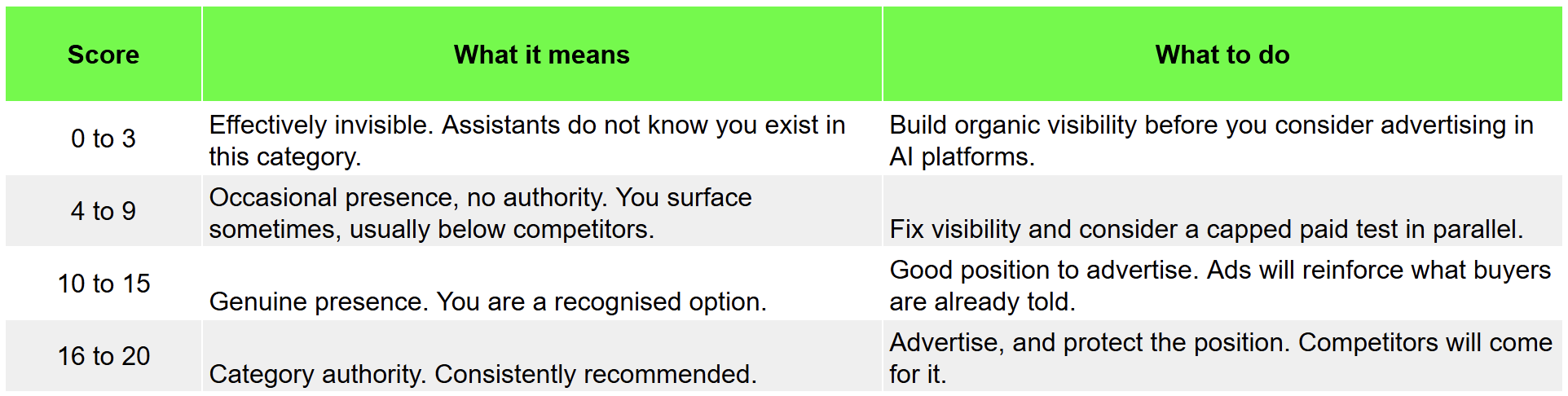
Two points every time you are named in the top three. One point when you are named further down. Zero when you are absent. Ten questions, so twenty is the maximum per assistant.
This is where the real value sits, and most people skip it.
Who is being recommended instead of you, and what do they publish that you do not?
This is the single most useful output of the exercise. Go and look at those businesses. Usually you will find consistent, specific, well-structured content answering exactly the questions you just asked, plus coverage in places you have never approached.
When you are mentioned, is the description accurate?
Being named for the wrong specialism is its own problem, and usually traces back to inconsistent information about your business across the web.
Is anyone named at all?
In some Australian categories, assistants hedge and decline to name businesses. If that is your category, the opportunity is wide open and whoever establishes themselves first takes it.
If you scored low, resist two instincts. Do not immediately buy advertising in AI platforms, because ads appear beneath the assistant’s own answer and land as an interruption when the assistant has never heard of you. And do not simply publish more blog posts, since most AI citations come from earned media rather than brand-owned pages.
Start instead with entity clarity, make sure your business is described consistently everywhere it appears, then publish genuine answers under named authors, then earn third-party coverage.
If you scored well, two things. Protect it, because it is a defensible asset competitors will target. And consider whether paid placement is now worth testing, since ads work considerably harder when the assistant already recommends you.
We explain how to decide in organic or paid in AI search, and why smart businesses do both.
AI answers shift as models update and competitors publish. A score from six months ago tells you very little. Keep the same ten questions, run them every quarter, keep everything in one spreadsheet, and watch the direction of travel. The trend matters more than any individual score.
Run the check tonight. Whatever comes back, you will know more about your market position than you did this morning. Talk to Hunt + Hawk. if you want help reading the results.
How do I check if ChatGPT recommends my business?
Open a temporary chat, so personalisation does not skew the result, and ask ten questions your buyers genuinely ask before choosing a provider in your category. Record whether you are named, where you appear, and which competitors are named instead. Repeat in at least one other assistant.
Why does being logged in affect the result?
Assistants personalise responses using memory of previous conversations and account context. If you have ever discussed your own business in that account, it is likely to surface it back to you, producing a flattering result that does not reflect what a prospective buyer would see.
What is a good AI visibility score?
Using the ten-question method, a score above ten out of twenty suggests genuine presence in your category. Below four suggests assistants effectively do not know you exist. Compare against your own trend over time rather than treating any threshold as definitive.
How often should I check?
Quarterly. AI answers change as models are updated and as competitors publish, so a single snapshot has limited value. The pattern across several quarters is what tells you whether your work is landing.
Can Hunt + Hawk run this audit for us?
Yes. We run the full version across every major assistant, with competitor analysis and a prioritised plan for what to fix first. Our free workbook also walks you through doing it yourself, and we are happy for you to do exactly that.