What Is AEO? The Plain-English Guide for Australian Businesses
What Is AEO? The Plain-English Guide for Australian Businesses
• Answer Engine Optimisation (AEO) is the practice of making your business appear, accurately, in the answers AI assistants give when someone asks a question in your category.
• Where SEO aims to rank a page in a list of results, AEO aims to be the source the answer is built from. There is no list to be tenth in.
• It matters because a growing share of buyers now research with AI assistants before they visit a website or contact a vendor, and shortlists are forming in conversations you cannot see.
• AEO is not a replacement for SEO. Well-structured, genuinely useful pages serve both, and most of the groundwork overlaps.
• Hunt + Hawk builds AI search foundations for Australian businesses, from mapping the questions worth winning through to the content and coverage that wins them.
Answer Engine Optimisation is the practice of improving how your business appears in the answers produced by AI assistants such as ChatGPT, Google’s AI results, Perplexity, Copilot and Claude.
The distinction from SEO is simple once you see it. Search engine optimisation aims to rank a page among a list of results, where being third or fourth still earns a click. Answer engine optimisation aims to be part of the answer itself, where there is no list, no second page and no consolation position. Either the assistant names you, or it names someone else.
That is the whole discipline in a sentence. Everything else is working out how to be named.
Because a meaningful and growing share of research happens before anyone visits your website.
AI search platforms now account for roughly 9% of search traffic in recent analysis, up from under 8% a year earlier, with ChatGPT taking the clear majority of that activity. Those figures vary considerably by study, and anyone quoting a single confident number is overstating what is actually known. Google still handles the overwhelming majority of traditional search.
But the share figure is not really the point. The behaviour change is. Buyers use AI assistants for exactly the questions that decide who makes a shortlist: what are my options, what should I look for, who is good at this in my city. Those used to be the questions your blog answered and your sales team reinforced. Now a machine answers them, usually without a click, and often before you know the buyer exists.
For Australian businesses there is an additional wrinkle. Many global comparisons are built on US data, and local answer quality varies. In some categories Australian assistants hedge and refuse to name businesses at all, which means the field is wide open for whoever establishes themselves first.
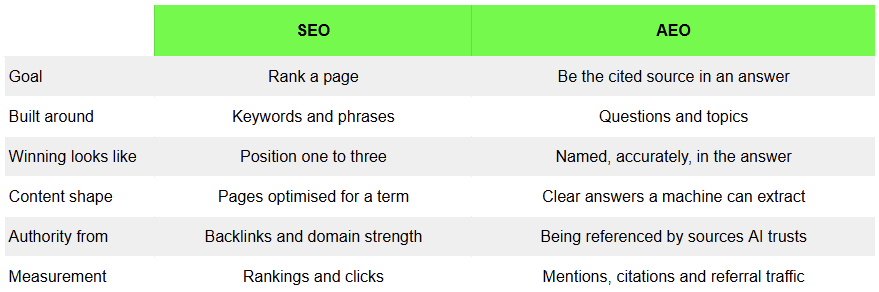
The important thing this table does not show is how much overlap there is. Pages that load quickly, are clearly structured and genuinely answer a question perform well in both. Technical hygiene serves both. A clear site architecture serves both.
What changes is emphasis. SEO rewarded comprehensive pages built around terms. AEO rewards direct answers to specific questions, published by identifiable experts, corroborated elsewhere. If your content strategy is already built around genuinely helping people rather than hitting keyword density, you are further along than you think.
There is no published algorithm, and anyone claiming certainty is guessing. But the observable patterns are consistent.
Entity clarity. The assistant needs to be confident about who you are, what you do and where you operate, and that the business mentioned in one source is the same one mentioned in another. Inconsistent descriptions across your website, directories and profiles make you harder to resolve, and harder to recommend.
Corroboration. A claim made only on your own site is a claim. The same claim reflected in industry press, a podcast, a client case study and a directory becomes a fact as far as a machine is concerned. One analysis found the large majority of AI citations come from earned media rather than brand-owned pages, which is why publishing alone rarely moves the needle.
Specificity. “Full-service agency” gives an assistant nothing to attach you to. “B2B marketing agency in Brisbane specialising in professional services” gives it a shelf to put you on.
Extractability. Clear headings phrased as questions, the answer in the first two lines, short paragraphs, real specifics. Content that buries its point does not get quoted.
Recency. Content untouched for two years signals an inactive business.
It is not a quick technical fix. There is no equivalent of a meta description to tweak. It’s all about building reference credibility, establishing your business as an authority and this requires strategy to navigate effectively.
It is not a reason to abandon SEO. Most businesses are still getting the majority of their discovery through conventional search, and will for some time.
It is not solved by publishing more blog posts, which is the most common and most expensive mistake, its about producing the RIGHT blogs.
And it is not a guarantee. You are optimising for systems whose workings are undisclosed and which change frequently. What you are really doing is making your business easier to understand, verify and recommend, which has always been good practice and now has a new payoff.
Wondering how paid activity fits alongside this work? We break down organic and paid strategies in AI search.
Not sure whether AI assistants know you exist? Talk to Hunt + Hawk, or run the check yourself first. We will tell you honestly either way.
What does AEO stand for?
AEO stands for Answer Engine Optimisation. It is the practice of improving how a business appears in answers generated by AI assistants, as distinct from ranking in a traditional list of search results.
Is AEO replacing SEO?
No. Traditional search still accounts for the majority of discovery, and well-built pages serve both purposes. AEO is better understood as an extension of search work rather than a replacement for it, with more emphasis on direct answers, author credibility and third-party corroboration.
How do I know if AI assistants are recommending my business?
Ask them. Use a temporary or logged-out chat, so personalisation does not skew the result, and put ten real buyer questions to at least two assistants. Record whether you are named and who appears instead. Repeat quarterly, because answers shift as models update.
How long does AEO take to work?
Technical and entity fixes show up within weeks. Content and author credibility build over several months. Earned coverage compounds over six to twelve months and keeps working afterwards.
Does Hunt + Hawk offer AEO services in Brisbane?
Yes. Hunt + Hawk is a Brisbane-based B2B agency building AI search foundations for businesses across Australia, covering question mapping, content and authored thought leadership, earned coverage, and the CRM measurement that connects it to revenue.