How to Use B2B Content Writing Services in 2026

How to Use B2B Content Writing Services in 2026
A $60 article from a freelance marketplace will never move a $250,000 enterprise deal. Not because the writer is bad, but because you have bought the wrong thing entirely.
I want to be fair about this. Marketplaces like Fiverr and Upwork are useful. If you need a product description rewritten, a job ad tidied up or an ebook formatted, they are efficient and I would use them. The problem is what happens when a B2B marketing leader treats complex, multi-stakeholder buyer journeys as a words-per-dollar purchase.
Because that is the actual decision being made. You are not buying 1,200 words. You are buying the judgement about what those 1,200 words should argue, who they should be aimed at, where they sit in a buying process that runs six to eighteen months, and how anyone will know whether they contributed to revenue. None of that is in the brief you can write into a marketplace order form, and none of it is in the price.
Here is how to actually use B2B content writing services in 2026, and how to tell the difference between a supplier and a growth partner.
B2B content writing services are the strategy, production and measurement of written assets that move a defined buying committee through a defined purchase decision. In 2026 that includes search-optimised articles, but it also includes sales enablement collateral, case studies, technical explainers, email sequences, landing pages, proposal language and the messaging architecture that holds all of it together.
The word “writing” is doing a lot of work there, and it is misleading. The writing is the last 20% of the job. The first 80% is deciding what needs to be said, to whom, and why anyone should believe it.
Three things shifted, and they compound.
Generative AI commoditised competent prose. The ability to produce clean, grammatical, on-topic copy is no longer scarce or valuable. Anyone can generate it in seconds. That means the entire value of a content writing engagement has migrated upstream into the thinking, the domain expertise and the distribution strategy. If your supplier’s differentiator was that they write well, they no longer have one.
Buyers now start with an answer engine. A significant and growing share of B2B research begins with a question typed into an AI assistant rather than a search box. The output is a shortlist, not ten blue links. Getting cited in that shortlist depends on whether your content contains specific, attributable, expert claims that a model can lift with confidence. Generic content is invisible to this. It is not ranked lower, it is simply not selected.
Buying committees got bigger and more risk-averse. Enterprise and mid-market purchases now routinely involve finance, IT, security, procurement, legal and the actual user. Each of those people is asking a different question and carries a different fear. Content that addresses one of them fails with the other five.
A marketplace writer with no context on your market cannot solve for any of that. They were never asked to.
Look at the second row. Unit cost is the metric that makes marketplace writers look attractive and the metric that matters least. Cost per qualified opportunity is the one your CFO should be asking about, and on that measure cheap content is frequently the most expensive thing in the budget, because it consumes management time, produces nothing, and delays the point at which you find out.
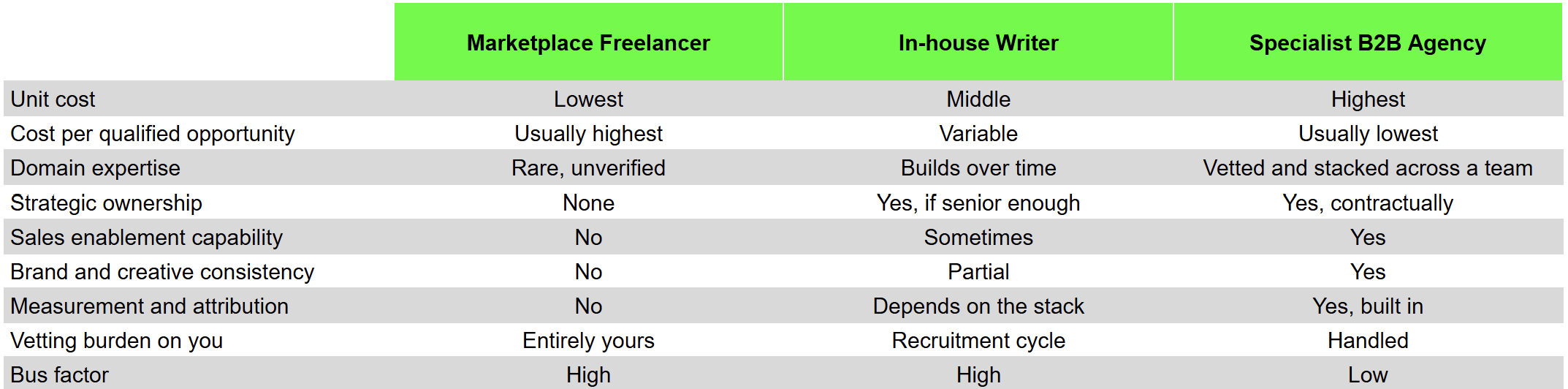
This is the part marketing leaders underestimate. When you buy content from a marketplace, you inherit the entire management burden.
You write the brief. You explain your market. You review the draft. You send it back because the writer has misunderstood how your product actually works. You review it again. You edit it yourself because it is faster than another round. You do the SEO structure. You source the internal links. You brief the designer separately. You chase the writer who has gone quiet. You start again with a new one in four months when they move on.
Price that at your own hourly rate and the $60 article is not a $60 article. For most marketing leaders I speak to, it is closer to $600 once their own time is counted, and the output is still weaker than what an experienced team would have delivered without supervision.
Why go through the pain of finding, testing, briefing and replacing writers yourself when a vetted resource already sits inside an agency that has done the vetting for you?
Strong business content creation starts by accepting that “the customer” does not exist. A buying committee does. Each member needs different content and none of them will read the others’ material.
The economic buyer, usually a CFO or managing partner. Wants the commercial case. Cost of the problem, cost of the solution, payback period, risk of doing nothing. Responds to numbers and comparables, not features.
The technical evaluator, usually IT or security. Wants integration detail, data handling, compliance posture, architecture. Will actively distrust marketing language and needs material written by someone who understands the domain.
The champion, usually the department head. Needs to sell this internally without you in the room. Needs a business case they can forward, a one-page summary, and answers to the objections their colleagues will raise.
The end user. Wants to know what their day looks like afterwards. Responds to workflow detail and honest change management, not vision statements.
Procurement. Wants comparison, contract terms and evidence of similar deployments. Case studies with specifics do the work here.
If you audit your existing library against those five roles, most B2B firms discover they have written for the champion and nobody else. That is the single most common gap I find, and it explains a lot of deals that stall after a good first meeting.
Content marketing for B2B fails most often because every asset is measured with the same metric. Different stages do different jobs.
Top of funnel. Thought leadership, category education, opinion and original research. The job is to be found and remembered. Judge it on qualified traffic, branded search growth, citations in AI answers and share of voice. Do not judge it on conversions, and do not gate it.
Middle of funnel. Comparison guides, buyer checklists, technical explainers, webinars, ROI models. The job is to help someone build a shortlist and an internal case. Judge it on engaged sessions, return visits, content consumed per account and demo or enquiry rate. This is where B2B lead generation content actually earns its name.
Bottom of funnel. Case studies with real numbers, implementation detail, security and compliance documentation, objection-handling one-pagers, proposal language. The job is to reduce perceived risk. Judge it on deal velocity, win rate and stage conversion, not on traffic. Almost nobody visits these pages, and they are the most commercially valuable assets you own.
Post-sale. Onboarding content, adoption material, expansion cases. In SaaS this drives net revenue retention. In professional services it drives cross-sell into other service lines. Both are cheaper growth than new logos and both are chronically under-resourced.
If you cannot connect content to revenue, you will lose the budget argument eventually. Set this up before you commission anything.
Instrument first. Content should be tracked in the same system as your pipeline. As a HubSpot Platinum Partner we do this in HubSpot, with lifecycle stages, deal stages and attribution configured against how the business actually sells rather than a default template.
Use multi-touch, not last-touch. Last-touch attribution will tell you that your pricing page closes all your deals. It is technically true and completely useless.
Measure at account level, not lead level. In complex B2B, six people from one company read your content and only one fills in a form. Lead-level reporting will miss the other five and undervalue everything.
Track content consumed per closed-won deal. This is the most useful number most firms do not have. It tells you which assets appear in deals that close, which is a better guide to what to produce next than traffic ever will be.
Give it a realistic window. If your sales cycle is nine months, judging a content programme at 90 days is measuring the wrong thing. Set leading indicators for the short term and revenue for the long term.
Content writing for enterprises is not a text problem. It is a coherence problem.
The buyer who reads your article, then your case study, then your proposal, then sits in a meeting with your sales lead, is forming one impression across all four. If the article sounds like a thought leader, the case study looks like a template, the proposal reads like a legal document and the sales deck was built the night before, you have not delivered a message. You have delivered noise, and in a considered purchase, noise reads as risk.
This is why we do not sell content writing as a standalone line item. The positioning, the visual identity, the messaging architecture, the campaign creative and the sales collateral have to come from one accountable team, or the seams show exactly where you cannot afford them to. We have written before about why branding, marketing and sales strategy are three different disciplines that too many businesses treat as one — and about what it actually means when your brand’s visual and verbal identity fall out of alignment. Content is usually where that misalignment gets noticed first, because it is the asset a prospect reads most closely.
Not every business needs a full retained programme, and any agency that tells you otherwise is selling rather than advising.
A fractional engagement suits you if: you have some internal marketing capability but no senior strategic direction, your content output is inconsistent rather than absent, you need expert input on strategy and quality control more than volume, or you want to test the relationship before committing. In practice this looks like fractional marketing leadership plus a defined content cadence.
A wider engagement suits you if: you are entering a new market or launching a new service line, you have no internal marketing function to speak of, your brand and content need rebuilding together rather than sequentially, or you need sales enablement and demand generation running in step rather than as separate projects.
The honest test is this. If the gap is capacity, hire or contract for capacity. If the gap is judgement, buy judgement. Most firms that think they have a capacity problem have a judgement problem, which is why adding a cheap writer to a broken strategy produces more content and no more pipeline.
Whether you engage an agency or a freelancer, no piece of content should be commissioned without these:
- • The specific buying committee role it targets
- • The funnel stage and the single job it has to do
- • The commercial question it must answer
- • The proof points, data or client evidence available
- • The objection it needs to defuse
- • Where it will be distributed and what it links to
- • The metric that will judge it and the date it will be judged
If your supplier cannot use that brief, they are not equipped for B2B. If they can improve the brief, you have found the right partner.
Buying content by the word made sense when words were scarce. They are not any more. What is scarce in 2026 is someone who understands your market, knows which argument will land with a sceptical CFO, can write it in a way an answer engine will cite, and is accountable for whether it produced revenue.
That person is not $60 an hour, and they are difficult to find on your own. The point of a good agency is that the finding, vetting and managing has already been done, and the subject matter expert sits inside a team that can take their thinking through to brand, creative, campaign and sales collateral without anything getting lost between suppliers.
Daniel Swann is Marketing Director at Hunt + Hawk, a HubSpot Platinum Partner working with B2B SaaS and professional services firms across Australia. If your content is producing traffic but not pipeline, book a growth audit and we will show you where it is breaking.
What are B2B content writing services?
B2B content writing services cover the strategy, production and measurement of written assets that move a business buying committee through a purchase decision. This includes articles, case studies, sales collateral, email sequences and messaging architecture, aligned to funnel stage and measured against pipeline rather than traffic.
Are freelance marketplace writers good enough for B2B content?
For simple, low-stakes copy they are efficient and cost-effective. For complex B2B purchases they usually are not, because they lack domain expertise, buying committee context, sales enablement capability and any accountability for pipeline. The management and quality control burden also transfers entirely to you.
How much do B2B content writing services cost?
Marketplace rates start at tens of dollars per piece, specialist B2B agencies typically work on monthly retainers or project fees running into the thousands. The more useful measure is cost per qualified opportunity, on which cheap content frequently performs worst because it consumes internal time and generates no pipeline.
What is the difference between a fractional and a full agency engagement?
A fractional engagement provides senior strategic direction and a defined content cadence alongside your existing team, suiting firms with capability but no leadership. A full engagement covers brand, content, demand generation and sales enablement end to end, suiting firms rebuilding or launching without an internal marketing function.
How do you measure the ROI of B2B content?
Track content in the same system as your pipeline, use multi-touch attribution at account level rather than last-touch at lead level, measure content consumed per closed-won deal, and set the measurement window to match your sales cycle. Leading indicators in the short term, revenue in the long term.