Hunt + Hawk Wins a 2026 Australian Good Design Award
Hunt + Hawk Wins a 2026 Australian Good Design Award
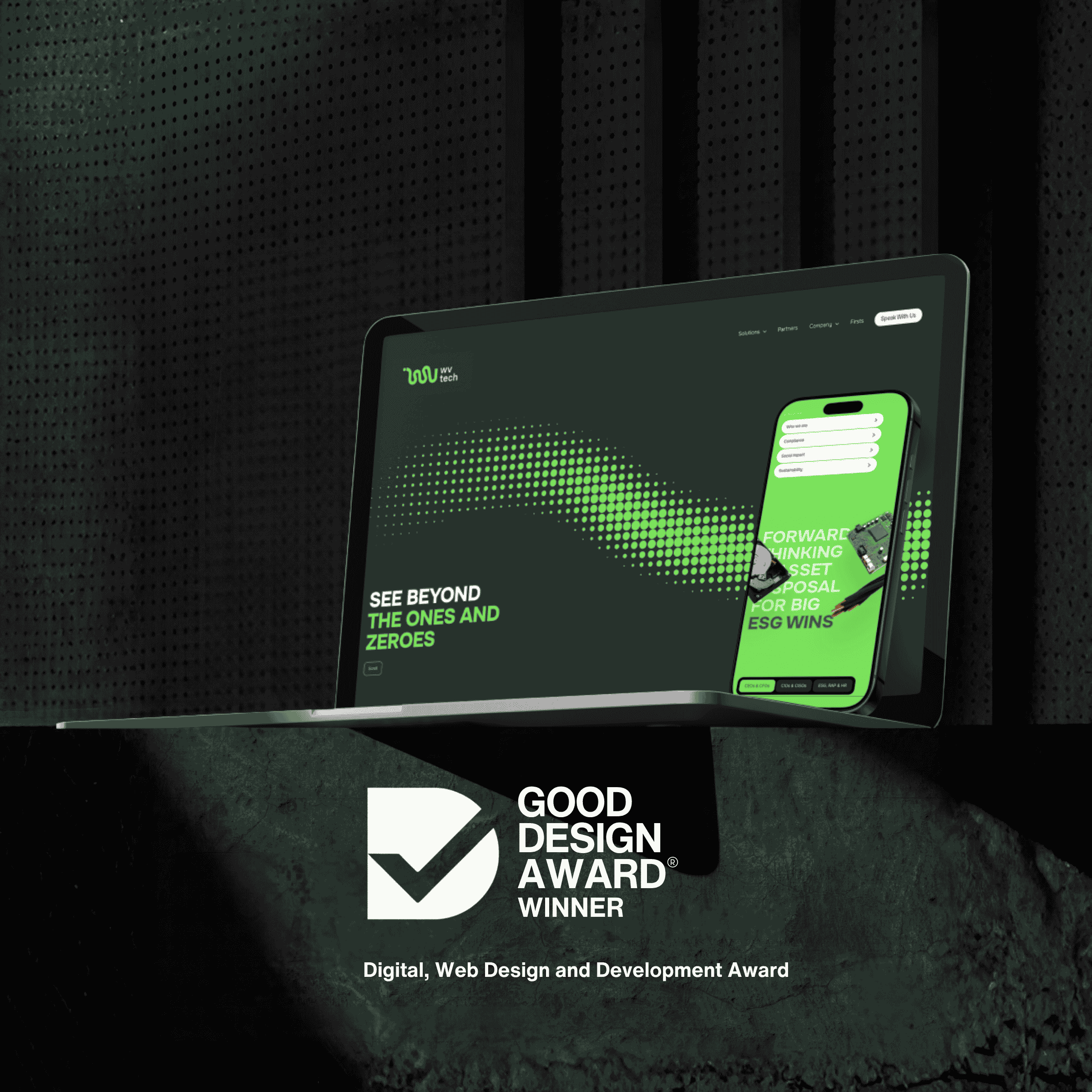
Hunt + Hawk has been recognised in the 2026 Australian Good Design Awards, winning in the Digital Design, Web Design and Development category for the project Seeing Beyond the Ones and Zeros.
The Australian Good Design Awards were established in 1958 and are Australia’s longest-running international design awards, with every entry judged by an independent jury of more than 100 Australian and international design experts against three criteria: good design, design innovation and design impact.
This year’s awards were presented under the theme Design that Leads, recognising the role design plays in navigating complexity and creating change.
The jury’s comments described a project that transforms a complex IT asset disposal offering into a clear, compelling and engaging digital experience, singling out the strategic use of persona-driven pathways and commending the confident visual identity, distinctive interaction design and clear presentation of impact metrics.
The line we are proudest of is the one about balance: the jury noted the design successfully balances enterprise credibility with authentic social and environmental purpose, delivering commercial, environmental and social outcomes through a single cohesive approach.
That balance was the hardest part of the brief, and it is the part most likely to be useful to anyone reading this who has a similarly difficult story to tell.
IT asset disposal is not an easy thing to make anyone care about.
The category deals in decommissioned hardware, data destruction, compliance obligations, resale value recovery and environmental outcomes. It is technically complex, heavily regulated, commercially unglamorous and genuinely important, which is a combination that defeats most marketing.
It also has a buying committee problem. A sustainability lead, an IT director, a procurement manager and a CFO all care about completely different aspects of the same service. The sustainability lead wants diversion from landfill. The IT director wants certified data destruction. Procurement wants process and compliance. Finance wants recovered value.
Most websites in this situation pick one audience and lose the rest, or try to speak to everyone and connect with nobody. That is the sameness trap we have written about elsewhere, and in technical categories it is especially severe, because the easy default is to lead with specifications.
Persona-driven pathways. Rather than one undifferentiated story, the site routes different visitors toward the version of the argument that matters to them, without fragmenting the brand into four separate identities. Each audience gets a path. The business keeps one voice.
Impact made visible. Environmental and social outcomes are frequently claimed and rarely evidenced. Presenting real impact metrics clearly, rather than burying them in a sustainability statement, turns a claim into proof, which is what sceptical enterprise buyers actually need.
Credibility and purpose held together. Enterprise buyers need confidence that a provider is serious, rigorous and safe to choose. Purpose-driven buyers need to believe the environmental and social commitments are real. Those two requirements often pull a brand in opposite directions, and holding them together was the central design challenge.
Distinctive interaction design. In a category where every competitor looks like a logistics provider, being memorable is a commercial asset rather than a creative indulgence.
Awards are pleasant and they are not the point. What this project demonstrates is something we argue with clients constantly: that creative work and commercial outcomes are not competing priorities.
The temptation in a technical category is to assume the complexity rules out distinctiveness, that the work must be functional and that interesting design belongs to consumer brands. The result is an entire sector of websites that look identical, compete on price, and leave their buyers to do all the differentiation work themselves.
The opposite is true, and this project is evidence. The more complex the offering, the more valuable clarity becomes, and the more rewarding distinctiveness is. A buyer who can finally understand what you do, and who remembers you afterwards, is worth a great deal more than one who has been shown a specification sheet.
We have written about that argument in What Makes Branding “Creative”? Why Safe Brands Cost SMEs More Than Bold Ones and in Brand-Led Growth: How Creative Branding Feeds Your Sales Pipeline. This is what it looks like when it works.
To our client, for being brave enough to back a genuinely different approach in a conservative category. The best work always requires a client willing to take the more interesting path, and this one did.
To the Hunt + Hawk team who built it, across strategy, design, content and development.
And to Good Design Australia and the jury, for recognising it.
The 2026 Australian Good Design Awards Ceremony takes place on Friday 9 October at ICC Sydney.
What are the Australian Good Design Awards?
Established in 1958, the Australian Good Design Awards are Australia’s longest-running international design awards and one of the world’s most respected design recognition programs. Entries are judged by an independent jury of more than 100 Australian and international design experts against three criteria: good design, design innovation and design impact.
What did Hunt + Hawk win the award for?
Hunt + Hawk received a 2026 Australian Good Design Award in the Digital Design, Web Design and Development category for Seeing Beyond the Ones and Zeros, a project that turned a complex IT asset disposal offering into a clear, persona-driven digital experience balancing enterprise credibility with social and environmental purpose.
Is Hunt + Hawk a Brisbane agency?
Yes. Hunt + Hawk is a Brisbane-based creative and growth agency working with B2B businesses across Australia and internationally, bringing branding, marketing, sales and CRM together under one roof.
Does Hunt + Hawk work with technical or complex B2B businesses?
Yes. Much of our work is in categories that are technically complex or heavily regulated, including technology, engineering, professional services and industrial businesses, where the challenge is usually making a genuinely complicated offering clear and memorable without oversimplifying it.