Best Email Marketing Software in 2026: Compare the Top Platforms for Growing Businesses

Best Email Marketing Software in 2026: Compare the Top Platforms for Growing Businesses
Choosing email marketing software isn’t simply about finding a platform that sends emails.
It’s about selecting a system that supports your marketing strategy, scales with your business, and helps connect marketing activity to measurable business outcomes.
Today’s email marketing platforms offer far more than newsletter creation. Many include marketing automation, CRM integration, customer segmentation, reporting, lead nurturing, SMS marketing, and even sales pipeline management.
The challenge isn’t finding software with the most features—it’s identifying the platform that best aligns with your business goals.
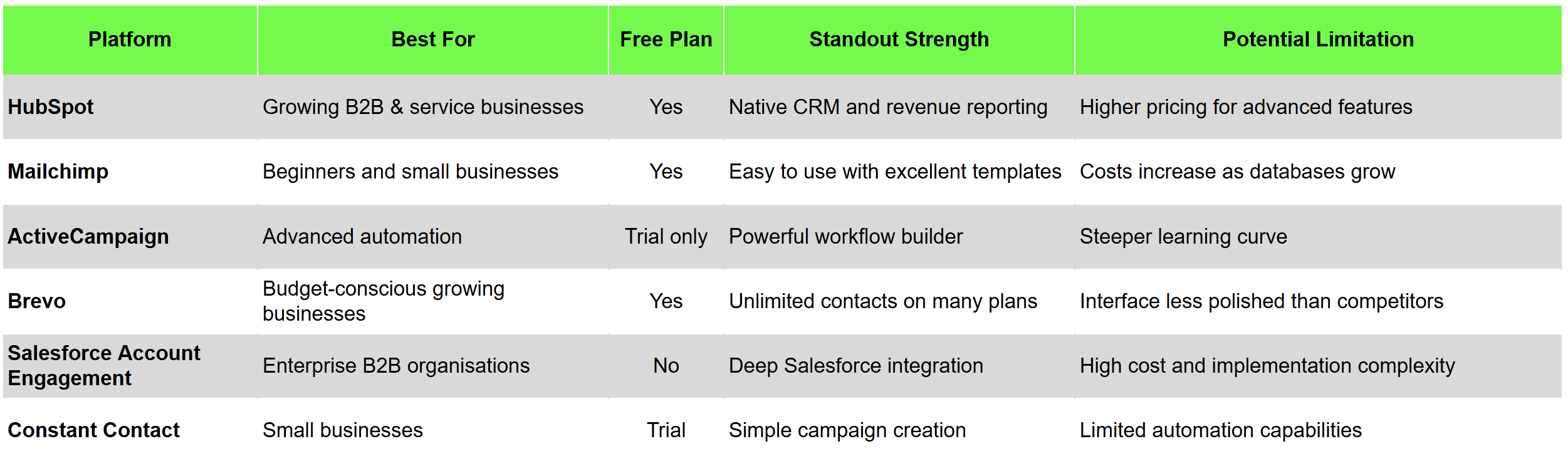
In this guide, we’ll compare six of the leading email marketing platforms for 2026, highlighting where each solution excels, where it has limitations, and the types of businesses it’s best suited for.
While every platform can send email campaigns, the experience and capabilities differ significantly.
Let’s examine each option in more detail.
Best For
Growing B2B companies and service businesses that want marketing, sales, and CRM data in one connected platform.
Why Businesses Choose HubSpot
HubSpot combines email marketing with a built-in CRM, allowing marketing and sales teams to work from the same customer database.
Instead of synchronising separate systems, businesses can manage contacts, deals, marketing campaigns, forms, workflows, and reporting within a single platform.
This unified approach provides greater visibility across the customer journey and reduces many of the reporting challenges associated with disconnected tools.
Key Features
• Drag-and-drop email builder
• Built-in CRM
• Dynamic segmentation
• Marketing automation workflows
• Landing pages and forms
• Lead nurturing
• Smart content
• Pipeline reporting
• Revenue attribution
• A/B testing
Advantages
✔ Native CRM integration
✔ Strong marketing and sales alignment
✔ Excellent automation capabilities
✔ Comprehensive reporting
✔ Extensive training through HubSpot Academy
Considerations
The biggest consideration is pricing.
While HubSpot offers free and entry-level plans, businesses requiring advanced automation, attribution reporting, and sophisticated workflows should expect a significant increase in investment as they move to Professional tiers.
Choose HubSpot If…
• CRM integration is a priority
• Sales and marketing collaborate closely
• Lead nurturing is central to your strategy
• Revenue attribution matters
• You want software that scales with business growth
Best For
Small businesses and organisations launching their first email marketing campaigns.
Why Businesses Choose Mailchimp
Mailchimp remains one of the most recognised names in email marketing because it’s approachable, intuitive, and easy to learn.
Its drag-and-drop editor, extensive template library, and simple campaign builder make it attractive for businesses with limited marketing resources.
Key Features
• Drag-and-drop email editor
• Mobile-responsive templates
• AI-assisted content tools
• Basic audience segmentation
• Campaign reporting
• A/B testing (selected plans)
• Ecommerce integrations
Advantages
✔ Beginner-friendly interface
✔ Fast campaign creation
✔ Large template library
✔ Wide range of third-party integrations
Considerations
As subscriber lists grow, pricing can increase substantially.
Businesses should also understand how contacts are counted for billing, particularly archived, inactive, or unsubscribed contacts.
While Mailchimp offers automation, organisations requiring sophisticated customer journeys may eventually outgrow its capabilities.
Choose Mailchimp If…
• You’re new to email marketing
• Your subscriber list is relatively small
• Ease of use is more important than advanced automation
• You already use another CRM
Best For
Businesses that prioritise marketing automation and complex customer journeys.
Why Businesses Choose ActiveCampaign
ActiveCampaign has built its reputation around automation.
Its visual workflow builder allows marketers to create highly customised customer journeys based on behaviour, engagement, CRM activity, website visits, purchases, and many other triggers.
This makes it particularly attractive for businesses managing long sales cycles or sophisticated lead nurturing programs.
Key Features
• Visual automation builder
• Behaviour-based triggers
• Lead scoring
• Website tracking
• Conditional workflows
• Ecommerce automation
• CRM capabilities
• Campaign reporting
Advantages
✔ Highly flexible automation
✔ Strong lead nurturing tools
✔ Advanced behavioural targeting
✔ Built-in sales functionality on selected plans
Considerations
Although extremely capable, ActiveCampaign requires more learning than beginner-focused platforms.
There is also no permanent free plan, making it less accessible for organisations wanting to experiment before committing.
Choose ActiveCampaign If…
• Marketing automation is your top priority
• Customer journeys involve multiple decision points
• Your team is comfortable learning advanced software
• You need flexible workflow design
Best For
Businesses looking for affordable email marketing with CRM and SMS capabilities.
Why Businesses Choose Brevo
Brevo (formerly Sendinblue) offers an attractive combination of affordability and functionality.
Unlike many competitors that charge primarily based on contact numbers, Brevo often focuses more heavily on email sending volume.
This pricing approach can be particularly valuable for businesses managing large databases without sending campaigns every week.
Key Features
• Unlimited contacts on many plans
• Email campaigns
• Marketing automation
• SMS marketing
• Transactional email
• Built-in CRM
• Deal pipelines
• Forms and landing pages
Advantages
✔ Cost-effective pricing
✔ CRM included
✔ SMS and email in one platform
✔ Strong value for growing businesses
Considerations
Although feature-rich, the interface isn’t as refined as some competitors.
Support options also vary depending on subscription level, and larger businesses may eventually require more advanced CRM functionality.
Choose Brevo If…
• Budget is important
• You manage large subscriber lists
• You want email and SMS marketing together
• A lightweight CRM meets your needs

Best For
Enterprise B2B organisations already using Salesforce CRM.
Why Businesses Choose Salesforce Account Engagement
Formerly known as Pardot, Salesforce Account Engagement is designed specifically for organisations operating within the Salesforce ecosystem.
Rather than functioning as a standalone email platform, it connects marketing activity directly with Salesforce Sales Cloud, enabling advanced lead scoring, campaign attribution, and sales alignment.
Key Features
• B2B marketing automation
• Lead scoring and grading
• Behavioural workflows
• Campaign attribution
• Salesforce synchronisation
• Sales alerts
• Website tracking
• Enterprise governance
Advantages
✔ Native Salesforce integration
✔ Advanced lead management
✔ Enterprise reporting
✔ Sophisticated attribution
Considerations
Implementation requires significant planning and expertise.
For smaller businesses, the platform’s cost and complexity often outweigh its benefits.
Choose Salesforce Account Engagement If…
• Salesforce is your core CRM
• You operate a mature B2B sales process
• Lead scoring is business critical
• Enterprise reporting is essential
Best For
Small businesses seeking a straightforward email marketing platform.
Why Businesses Choose Constant Contact
Constant Contact focuses on helping businesses launch campaigns quickly.
The platform emphasises simplicity over advanced automation, making it ideal for teams without dedicated marketing specialists.
Key Features
• Drag-and-drop editor
• Extensive template library
• Email scheduling
• Contact management
• Social media tools
• SMS capabilities
• Campaign reporting
Advantages
✔ Quick setup
✔ Easy to learn
✔ Excellent template selection
✔ Suitable for small teams
Considerations
Businesses expecting sophisticated automation, CRM-driven segmentation, or advanced reporting may eventually outgrow the platform.
Choose Constant Contact If…
• You need simple campaign management
• Marketing requirements are straightforward
• Ease of use is your highest priority
• Your team has limited technical resources
Software demonstrations often focus on features.
But successful platform selection depends just as much on organisational fit.
When comparing email marketing platforms, consider:
• Business goals
• Customer journey complexity
• CRM requirements
• Team size
• Budget
• Internal expertise
• Scalability
• Reporting needs
• Automation maturity
The “best” software is rarely the one with the longest feature list.
It’s the one that solves your business problems most effectively.
Choosing email marketing software is a long-term business decision—not just a technology purchase.
If you’re evaluating platforms, Hunt + Hawk can help you assess your current marketing processes, compare solutions based on your business goals, and recommend the platform that best supports your growth strategy.
Up next in this series: How to Choose the Best Email Marketing Software for Your Business—a practical buyer’s guide covering evaluation criteria, common mistakes, vendor questions, and implementation considerations. This article is based on and reorganized from the source content you provided.
Which email marketing software is best overall?
There isn’t a universal answer. HubSpot is an excellent choice for businesses wanting CRM integration and advanced reporting, while ActiveCampaign excels in automation. Mailchimp, Brevo, Constant Contact, and Salesforce Account Engagement each serve different business needs.
Which platform is best for small businesses?
Mailchimp and Constant Contact are popular for businesses seeking ease of use, while Brevo offers excellent value for organisations wanting CRM, automation, and SMS capabilities.
Which platform offers the best automation?
Among the platforms compared here, ActiveCampaign stands out for its highly flexible visual workflow builder and behavioural automation capabilities.
Which platform integrates best with CRM systems?
HubSpot offers native CRM functionality, while Salesforce Account Engagement provides deep integration within the Salesforce ecosystem.