How to Run a Brand Identity Audit When Your Company Scales (2026 Guide)
How to Run a Brand Identity Audit When Your Company Scales (2026 Guide)
A brand identity audit is one of the most revealing exercises a scaling company can run — and one of the most consistently delayed.
Your brand probably worked perfectly when the company was small. Everyone knew the story. The founder reviewed every piece of content. Messaging stayed tight because the team sat in the same room. Then growth happened. New hires joined who weren’t there at the beginning. Departments multiplied. Suddenly your sales deck looks different from your website, and your social media sounds like a completely different company.
This is how brand identity breaks down during scaling — not through one dramatic failure, but through dozens of small misalignments that accumulate over time. Across more than 50 brand audits conducted with mid-to-large companies, Hunt + Hawk consistently finds the same three root causes: founder messaging that never gets documented, visual elements that drift channel by channel, and website copy that contradicts itself across pages.
This guide walks you through a diagnostic-first approach to auditing brand identity. You’ll learn why identity breaks down, how to spot the warning signs early, and a step-by-step process for running your own audit — including a brand audit checklist your team can use today.
• A brand identity audit is a structured evaluation of how your brand presents itself across every touchpoint — and whether that matches your intended positioning.
• Brand identity drift in scaling companies typically stems from three causes: messaging fragmentation, visual inconsistency across channels, and website copy that contradicts itself across pages.
• A thorough brand identity audit covers six areas: brand foundations, internal alignment, external presentation, customer perception, digital performance, and competitive positioning.
• Hunt + Hawk’s brand audit process typically takes 1–3 days depending on company size and complexity — significantly faster than the industry norm of 2–4 weeks.
• The most valuable audit outcome isn’t a list of problems — it’s a clear, prioritised picture of exactly where to focus brand improvement efforts.
• Scaling companies should conduct a full brand audit annually, with trigger-based audits after major changes such as new leadership, product launches, or market expansion.
A brand identity audit is a structured evaluation of how your brand presents itself across every touchpoint — and whether that presentation matches your intended positioning. It examines the gap between what you say you are and what customers actually experience.
For scaling businesses, this matters because brand inconsistency erodes trust faster than almost any other factor. Research by Brand24 found that 4 out of 5 consumers won’t buy from a brand they don’t trust. Every misaligned message chips away at that trust — often invisibly, until it starts showing up in conversion rates and sales cycle length.
The audit examines three core areas: internal branding (how your team understands and communicates the brand), external branding (how your brand appears to the outside world), and customer experience (how people interact with your brand at every stage of the buying journey).
Why Brand Consistency Audit Results Matter More Than You Think
A brand consistency audit doesn’t just reveal design problems. It surfaces strategic misalignment — between what leadership thinks the brand is, what sales communicates to prospects, and what customers actually experience. When these three are out of sync, no amount of marketing spend fixes the underlying problem.
According to Brandwatch, brands with inconsistent messaging spend significantly more on customer acquisition because they must constantly re-educate prospects. Consistent branding, by contrast, can increase revenue by 10–20% by strengthening recognition and buyer confidence.
Small companies don’t have brand consistency problems because control is centralised. When there are ten people, everyone knows the brand intuitively. The founder approves every proposal. The marketing manager checks every post.
Then the company grows. New people join who weren’t there at the beginning. A second office opens. The sales team expands. A marketing coordinator starts creating their own materials. Someone in another location produces a presentation with different colours and a different tone.
Across 50+ brand audits, Hunt + Hawk has identified three root causes that appear in almost every scaling company:
1. Messaging fragmentation — Founders describe the company one way, sales teams improvise based on what closes deals, and marketers over-optimise for individual channels. Nobody is deliberately misrepresenting the brand. They’re just filling in gaps that were never properly documented.
2. Visual drift — Logos get stretched or recoloured. Colours shift subtly across different file versions. Presentation templates accumulate edits from different team members over time. Each change seems minor — the cumulative effect is a brand that looks like several different companies.
3. Website inconsistency — The homepage says one thing, service pages say another, and blog content reflects yet another interpretation of the brand. This is one of the most damaging forms of drift because it affects buyers at the most critical moment of their decision-making process.
The Hidden Costs of Brand Drift
Brand drift has real financial consequences. When messaging is inconsistent, conversion rates drop because prospects receive conflicting signals about what you do and who you serve. The problem compounds during rapid growth — every new hire who doesn’t receive proper brand training becomes another vector for inconsistency.
The hidden cost is opportunity. Every confused prospect who chooses a competitor because your brand felt unclear represents lost revenue that compounds over time.
Warning sign 1: Customer confusion. When prospects ask basic questions your messaging should already answer, something has broken. If your team regularly hears “I thought you did X, not Y,” that’s a clear signal your external brand isn’t communicating your positioning clearly.
Warning sign 2: Internal inconsistency. Walk through your sales materials, website, social media, and email signatures. Do they all tell the same story? Are visual elements consistent? Does tone match across channels? If different departments describe the company differently when asked, the brand has fragmented internally.
Warning sign 3: Declining conversions despite increased awareness. If more people know about your brand but fewer are buying, the gap between expectation and reality is widening. This often signals a positioning problem that only a structured brand identity audit can uncover.
How to Spot Messaging Inconsistency Before It Costs You
Pull up your website homepage, most recent sales deck, LinkedIn company page, and last marketing email. Read the main value proposition from each. Are they saying the same thing?
Check the tone. Does your website sound formal while your social media sounds casual? Check the language. If your website describes your offering as “brand strategy” but your sales team calls it “marketing services,” that gap creates real friction for prospects trying to evaluate you.
A thorough brand identity audit follows a clear sequence. Start with your foundations, then examine internal alignment, external presentation, and customer perception. Each layer builds on the previous one.
Document everything as you go. Create a central repository for screenshots, notes, and observations — this becomes the evidence base for your action plan.
Step 1: Review Your Brand Foundations
Before examining execution, revisit your core brand elements. Pull out your mission statement, vision statement, and brand values. When were they last updated? Do they still reflect who your company has become?
Check your unique value proposition. Does it clearly explain what makes you different from alternatives? Can every team member articulate it consistently? If not, the foundation needs attention before you can fix downstream inconsistencies.
Assess your brand personality guidelines. Are they defined clearly enough that a new hire joining today would understand how to represent the brand? Vague guidelines lead to interpretation drift — everyone fills in the gaps differently.
Step 2: Audit Internal Brand Alignment
Your brand starts from the inside. A strong internal brand connects employees to the company’s values and mission. When internal alignment is weak, inconsistency leaks into every customer interaction.
Survey your team. Do they know the brand values? Can they explain what the company does in a consistent way? Pay close attention to how different departments describe the business — divergent internal narratives are a reliable signal of brand drift.
Review onboarding materials. Does new employee training include brand guidelines? If people join without understanding the brand, they’ll default to their own interpretations or habits from previous employers.
Step 3: Evaluate External Brand Presentation
Now examine every external touchpoint — website, social media profiles, email templates, sales collateral, advertising, PR materials, and any physical assets.
Check visual consistency first. Are logos used correctly everywhere? Do colours match your official palette? Is typography consistent? Visual drift is often the easiest problem to spot and fix — but it’s also the most visible to buyers, so it matters.
Then evaluate messaging consistency. Does your tone stay constant across channels? Does each piece of content reinforce the same core positioning? Note specific examples of inconsistency — these become priority action items.
Step 4: Gather Customer Perception Data
Your customers are the ultimate judges of your brand. Their perception reveals whether your intended identity actually comes through in practice.
Collect feedback through surveys, interviews, and review analysis. Ask customers what they think you do, why they chose you, and how they would describe you to a colleague. Compare their answers to your intended positioning — the gaps are where your brand is failing to communicate.
Monitor social listening. What are people saying about your brand online? Unfiltered feedback often reveals perception gaps that internal assessments miss entirely.
Step 5: Analyse Website and Digital Performance
Your website is typically the first touchpoint between your brand and a potential customer — and the most common place Hunt + Hawk finds brand consistency gaps. The homepage promises one thing, service pages deliver another message, and blog content reflects a third interpretation entirely.
Review user behaviour metrics. High bounce rates on key pages suggest messaging isn’t resonating. Short session durations indicate content isn’t engaging visitors. Low conversion rates often point to a positioning mismatch between what attracted the visitor and what the page delivers.
Check SEO performance. Are you ranking for terms that match your intended positioning? If your brand positions as a specialist but ranks only for generic terms, there’s a disconnect between identity and discoverability.
Step 6: Benchmark Against Your Market
No brand exists in isolation. Understanding your position relative to competitors helps identify differentiation gaps and sharpen your unique positioning.
Analyse how your messaging compares to direct competitors. Where do they outperform you in clarity? Where do you have advantages they don’t communicate effectively? This comparison reveals opportunities to sharpen what makes you genuinely different.
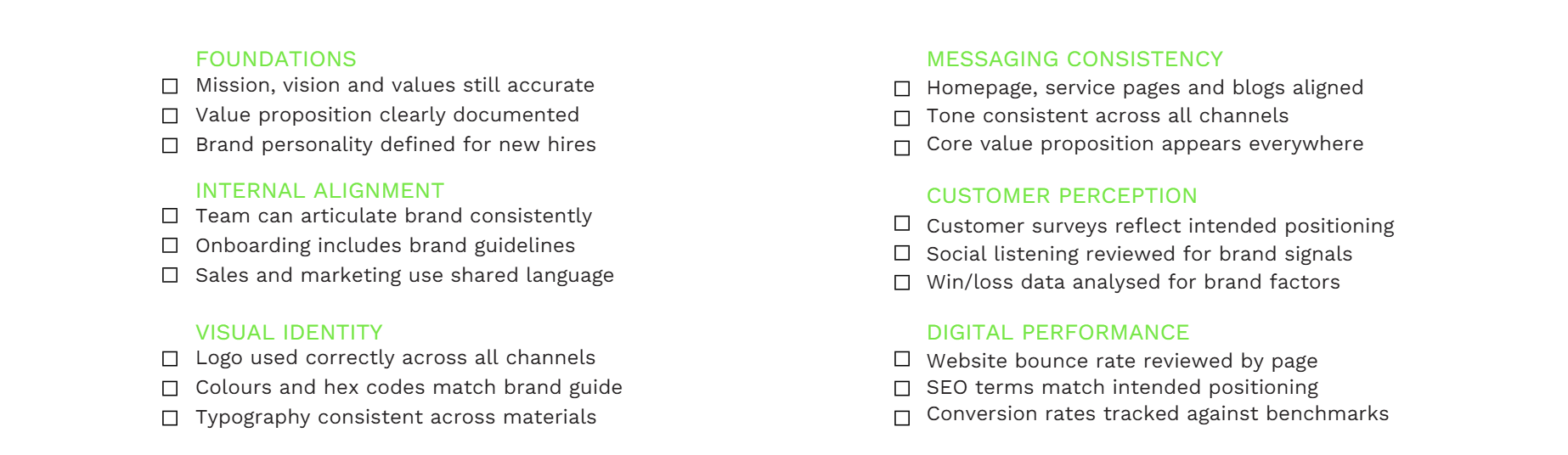
Use this brand audit checklist to structure your review. Work through each category systematically and document findings as you go.
Brand foundations
• Mission, vision, and values still reflect your current business
• Unique value proposition is clearly documented and current
• Brand personality is defined specifically enough for new hires to follow
Internal alignment
• Team members across departments can articulate the brand consistently
• New employee onboarding includes brand guidelines
• Sales and marketing teams use shared language for the same offerings
Visual identity
• Logo is used correctly and consistently across all channels and materials
• Colours match official hex codes from your brand guide — no variations
• Typography is consistent across your website, presentations, and documents
Messaging consistency
• Homepage, service pages, and blog content are aligned around one core positioning
• Tone of voice stays consistent across all channels
• Core value proposition appears in every key customer-facing touchpoint
Customer perception
• Customer surveys or interviews reflect your intended positioning
• Social listening has been reviewed for brand sentiment patterns
• Win/loss data has been analysed for brand-related factors
Digital performance
• Bounce rates reviewed by key page — high rates flagged for messaging review
• SEO keyword rankings match your intended positioning and expertise areas
• Conversion rates tracked against category benchmarks
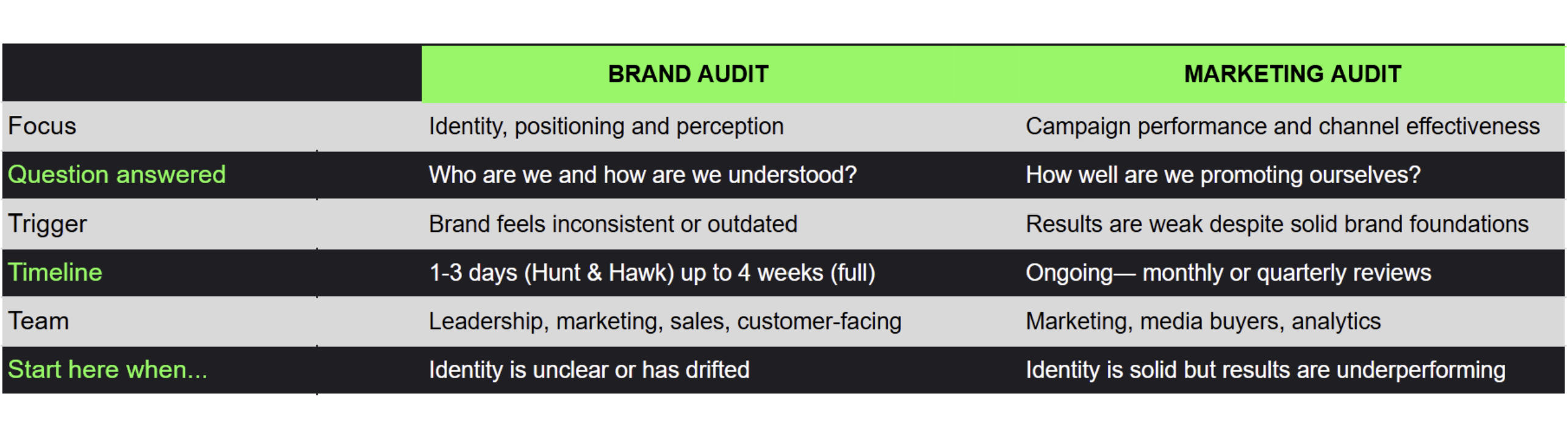
This is one of the most common questions scaling companies ask — and the distinction matters, because starting with the wrong audit wastes time and budget.
A brand identity audit examines who you are and how you’re understood. It evaluates your positioning, messaging, visual identity, and the perception customers have formed of your business. It’s a diagnostic exercise that surfaces strategic and identity gaps.
A marketing audit evaluates how well you’re promoting yourself. It examines campaign performance, channel effectiveness, conversion rates, and promotional ROI. It assumes your brand foundations are solid and focuses on optimising execution.
Start with a brand identity audit when: your brand feels inconsistent or outdated, different departments describe the company differently, or customers describe you in ways that don’t match your positioning.
Start with a marketing audit when: your brand identity is clear and consistent, but your campaigns aren’t generating the results you expect.
In practice, most scaling companies discover during a brand audit that their marketing problems have a brand root cause — not a media-buying or channel problem.
The right frequency depends on how fast your company is changing. Rapid growth — doubling headcount, entering new markets, launching new products — accelerates identity drift and demands more proactive monitoring.
As a baseline: conduct a full brand identity audit annually. Add lighter quarterly check-ins on key metrics like messaging consistency and customer perception scores. And trigger an immediate audit for major inflection points — new leadership, significant product launches, or entering a new market.ns

This depends on the scope of the audit and the size of the business. A common misconception is that audits require weeks of work. In Hunt + Hawk’s experience running 50+ brand audits for mid-to-large companies, a well-structured audit can be completed in 1–3 days — with the right framework and experienced eyes.
The typical timeline breaks down as follows:
- Day 1: Foundation review, internal alignment survey, and external touchpoint collection
- Day 2: Customer perception analysis, digital performance review, and competitive benchmarking
- Day 3 (if needed): Synthesis, prioritisation, and action plan development
Larger organisations with multiple brands, markets, or business units may require additional time. But for most scaling companies, the bottleneck isn’t the audit itself — it’s acting on the findings.
After gathering all findings, prioritise issues by impact and effort. Some problems are quick fixes with high impact — inconsistent logo usage across materials, for example. Others require significant investment — a complete messaging overhaul.
Create SMART goals for each action item. Instead of “improve messaging consistency,” specify “update website service page copy to align with sales deck positioning by end of Q3.” Concrete targets enable accountability and measurement.
Assign ownership for each item. Brand consistency fails when responsibility is diffuse. Every action item needs a specific person accountable for completion and a clear deadline for delivery.
Building Brand Guidelines That Teams Actually Use
If your audit reveals inconsistency, stronger guidelines are part of the solution. But the most common mistake is creating guidelines that are too complex to use in practice — a 60-page PDF nobody opens.
Effective brand guidelines include specific examples of correct and incorrect usage. Show how the logo should appear on different backgrounds. Demonstrate the difference between on-brand and off-brand tone with real examples. Store them where every team member can find them in under 30 seconds — a Figma file or Notion page that’s actually linked in onboarding beats a document buried in a shared drive.
Auditing without clear criteria. Random observation leads to subjective conclusions. Define specific standards before you start evaluating — what does “consistent” actually mean for your brand?
Skipping internal stakeholder input. Leadership often has blind spots about brand reality. Include customer-facing roles — sales and customer service see how the brand performs under real conditions every day.
Producing a report nobody acts on. An audit that ends with a document on a shelf wastes everyone’s time. Build action planning into the audit process from day one — findings without owners and deadlines don’t move.
Confusing a marketing audit with a brand audit. If your messaging is fundamentally unclear, optimising your media spend won’t fix it. Start with brand foundations before investing in promotional tactics.
Running a brand identity audit for scaling companies isn’t a one-time fix — it’s an ongoing habit that protects your brand equity as the business grows. Every new hire, new market, and new product launch creates fresh opportunities for drift.
The companies that maintain brand clarity through growth are the ones that catch drift early. They check the foundations annually. They train new hires on brand from day one. And when something feels off — when customer conversations start going sideways, or when conversion rates drop without an obvious cause — they run a diagnostic before throwing budget at the symptom.
Start with the brand audit checklist in this guide. Document what you find. Assign ownership. And if what you uncover feels bigger than an internal fix, bring in experienced eyes — a brand identity audit is significantly more valuable when conducted by someone who hasn’t normalised the inconsistencies you’re living with every day.
Hunt + Hawk has run brand identity audits for 50+ mid-to-large companies across multiple industries. Our process takes 1–3 days and delivers a clear, prioritised picture of exactly where your brand needs attention — and what to do about it. Contact us to book your brand audit.
What is a brand identity audit?
A brand identity audit is a structured evaluation of how your brand presents itself across all touchpoints — website, sales materials, social media, customer service, and more. It compares your intended positioning against actual customer perception to find the gaps.
The goal is identifying where your brand is inconsistent, outdated, or misaligned with your business as it exists today — not as it was when the brand was originally built.
How long does a brand identity audit take?
Hunt + Hawk’s brand identity audit process typically takes 1–3 days depending on company size and complexity. This covers foundation review, internal alignment, external presentation, customer perception analysis, and action planning.
Larger organisations with multiple brands or markets may require additional time. A DIY audit following the step-by-step process in this guide typically takes 2–4 weeks when completed by an internal team alongside other responsibilities.
How often should scaling companies audit their brand identity?
Conduct a full brand identity audit at least annually. If your company is growing rapidly — doubling headcount, entering new markets, or launching significant new products — increase the frequency to every 6 months.
Trigger an immediate audit for major changes: new leadership, significant product pivots, M&A activity, or any moment where customer perception feels misaligned with your positioning.
What are the most common brand identity audit findings?
Across 50+ brand audits, Hunt + Hawk consistently finds three issues appearing in almost every scaling company:
Messaging fragmentation — founders describe the company one way, sales teams improvise, and marketers over-optimise for individual channels. The result is a brand that says different things to different people.
Visual drift — logos, colours, and typography vary across channels and materials, creating a subtle inconsistency that erodes professionalism.
Website inconsistency — the homepage, service pages, and blog content reflect different interpretations of the brand, confusing buyers at the most critical point of their decision.
What is the difference between a brand audit and a marketing audit?
A brand audit examines your identity, positioning, and how customers perceive you — who you are and how you’re understood. A marketing audit evaluates campaign performance, channel effectiveness, and promotional ROI — how well you’re promoting yourself.
Both are valuable, but they answer different questions. Start with a brand audit if your identity feels unclear or inconsistent. Start with a marketing audit if your brand foundations are solid but your promotional results are underperforming.
Who should be involved in a brand identity audit?
Include representatives from marketing, sales, customer service, and leadership at minimum. Customer-facing roles see brand reality every day and often catch issues that leadership has normalised over time.
External auditors bring objectivity that internal teams typically can’t — familiarity makes it difficult to spot inconsistencies you’ve been living with for years.
What should I do after a brand identity audit?
Prioritise findings by impact and effort. Tackle quick, high-impact fixes first — these build internal credibility for larger brand investments. Assign ownership and deadlines to every action item. Create or update brand guidelines that reflect the decisions made. And schedule your next check-in before you finish acting on this one.
Can a brand identity audit be done internally?
Yes — the step-by-step process and brand audit checklist in this guide give you everything you need to run an internal audit. The main limitation is objectivity. Internal teams often miss inconsistencies they’ve normalised, and findings can be harder to act on when they challenge decisions made by leadership.
For audits that need to drive real organisational change, external facilitation is significantly more effective — both in surfacing what’s actually happening and in creating the buy-in needed to act on it.