How to Build a Clear Brand Identity for B2B SaaS Companies (2026 Guide)

How to Build a Clear Brand Identity for B2B SaaS Companies (2026 Guide)
Building a clear brand identity for B2B SaaS is one of the most common challenges facing fast-growing software companies — and one of the most overlooked revenue levers.
Your product is working. You have real customers, growing monthly recurring revenue, and a roadmap that keeps improving. But something feels off when prospects land on your website or review your pitch deck. The brand hasn’t kept up with the product.
This gap between product maturity and brand clarity is well documented. Brightscout calls it the “brand-product gap” — and it’s a revenue problem, not just a design problem. When your brand doesn’t reflect your product’s actual capabilities, you lose deals to more recognisable competitors and face longer sales cycles.
This guide covers everything you need to know about building a B2B SaaS brand strategy that grows with your company — from vision and positioning to messaging frameworks and a practical workshop you can run with your team this quarter. It draws on lessons from building and repositioning more than 35 B2B SaaS brands across Australia, the US, Singapore, and Europe.
- Brand identity for B2B SaaS includes positioning, messaging, voice, and visual systems — not just a logo.
- Growing SaaS companies typically face a brand-product gap where the product evolves faster than the brand narrative.
- A clear brand strategy aligns sales, marketing, and product teams around a unified value proposition.
- Workshop-led brand development helps leadership teams codify brand decisions into scalable, repeatable systems.
- Across Hunt & Hawk’s B2B SaaS client base, brand clarity work typically reduces sales cycle length by 20–30% within six months.
- Clients also report a 10–20% increase in inbound leads following brand strategy and positioning work.
- A brand refresh updates visuals and messaging; a full rebrand rethinks positioning, naming, and identity from the ground up.
Brand identity is the complete picture of how your company shows up in the market. It includes visual elements — logo, colours, typography — but also your voice, messaging, positioning, and the emotional connection you create with buyers.
For B2B SaaS companies, brand identity shapes how prospects perceive you before they ever speak to your sales team. According to Wunderdogs, investors evaluate pitch decks before they look at code, and enterprise buyers form impressions from your website before a single discovery call happens.
A strong brand identity reduces buyer uncertainty. It signals credibility, professionalism, and trustworthiness — all critical factors when customers are evaluating SaaS vendors with overlapping feature sets.
The Three Pillars of Brand Identity
Brand identity rests on three interconnected pillars:
Identity — the unique characteristics that define your brand’s personality and values.
Promise — what customers can reliably expect every time they engage with your product or team.
Signalling — how you communicate identity and promise through visual and verbal elements consistently across every touchpoint.
When these three pillars work together, you create an emotional connection that differentiates you from competitors who may offer similar functionality.
Why B2B SaaS Brands Need More Than a Logo
Many founders treat branding as a visual exercise — pick a logo, choose a colour palette, move on. That’s only a fraction of what brand identity actually is.
Research from Creative Instinct confirms that defining your brand strategy — purpose, personality, positioning, and voice — must happen before touching the visuals. The visuals should express the strategy, not substitute for it.
Growing SaaS companies face a predictable challenge: the product evolves faster than the brand. New features ship, the customer base expands, and positioning gets refined through sales feedback. Meanwhile, the brand materials remain frozen at an earlier version of the business.
This brand-product gap isn’t just a cosmetic issue. When your brand no longer matches your product maturity, you lose deals to more recognisable competitors and face longer sales cycles — even when your product is technically superior.
The “Sea of Sameness” Problem
A 2025 survey of 100 B2B SaaS marketing leaders by Wynter found that 94% of respondents felt trapped in what one CMO described as “the sea of sameness.” They knew their brand sounded like everyone else’s, had budgets to fix it, yet remained stuck.
The reason is consistent: bold ideas get watered down to “proven” formulas. Courage gets replaced by consensus. Brands end up with the same promises, the same language, and the same invisible positioning as their competitors.
Internal Disconnect Between Leadership and Marketing
One underappreciated cause of brand stagnation is the gap between leadership and marketing teams. When senior leaders have been promoted from operations, sales, or finance backgrounds, they may not have a strong intuition for brand strategy — and brand decisions get made based on hierarchy rather than expertise.
The result: a patchy brand presence, internal misalignment, and a marketing team executing directionless requests.
Your brand core is the strategic foundation that shapes every company decision. Before creating logos, taglines, or marketing materials, you need to clearly define your identity and values. A clear brand core brings alignment to your team, confidence to investors, and clarity to customers.
Companies with clearly defined purpose and values consistently outperform their competitors both financially and culturally.
How to Craft a Vision Statement That Actually Guides Decisions
Your vision describes where your company is going — the long-term future you want to create. It should be future-focused, concise, and explain the impact you aim to make.
A strong example: Tesla’s vision is “To accelerate the world’s transition to sustainable energy.” It’s clear, ambitious, and directional. A weak example: “To be the best company in the world.” That’s generic and offers no guidance.
For a growing B2B SaaS company, a vision statement might look like: “To become the most trusted workflow automation platform for mid-market finance teams.”
How to Write a Mission Statement That Drives Daily Work
Your mission explains how you’ll achieve your vision — the actions you take every day. It should describe exactly what you do and how you create value.
Google’s mission is a strong model: “To organise the world’s information and make it universally accessible and useful.” It’s specific and actionable. Compare that to “We aim to deliver excellence to all our customers” — which applies to any company in any industry.
Defining Brand Values That Shape Behaviour
Brand values are the behavioural rules that shape how your company acts internally and externally. They influence hiring, product development, customer interactions, and partnerships.
Strong values are actionable, memorable, and measurable. Your team should be able to practise them — not just read them on a wall. Ask yourself: how do we act when a customer is unhappy? What do we never compromise on, even under pressure?
B2B SaaS brand strategy outlines the core decisions that define who you are, what you stand for, whom you serve, and how you compete. It includes your brand purpose, vision, mission, target audience, value proposition, positioning statement, messaging pillars, and personality.
When these elements are clearly defined, your visual identity, communication, and customer experience all align toward one unified direction.
How to Create Audience Personas for B2B SaaS
Audience personas help you define exactly who your ideal customers are — their goals, behaviours, and challenges. Personas prevent guesswork and ensure your brand speaks directly to the people most likely to buy.
Common B2B SaaS personas include CMOs looking for more efficient marketing operations, operations managers needing workflow automation, and founders searching for scalable tools. Each persona requires different messaging and positioning, even if the product is the same.
Finding Your Unique Position in a Crowded Market
SaaS brand positioning defines the unique space you occupy in your customer’s mind. It explains why someone should choose you over any alternative — not just what you do, but why it matters to that specific buyer.
A core part of positioning is understanding what “job” your product is hired to do. Clayton Christensen’s Jobs to Be Done theory shows that customers “hire” products based on the outcome they want, not just the features they see. When you understand this, your brand can stand out through deeper relevance — not louder messaging.
Creating Your Brand Promise and Messaging Pillars
Your brand promise is the commitment you make to customers — the value they can expect every time they engage with your product. Messaging pillars support this promise by offering clear themes you communicate consistently.
For example, a B2B SaaS company might have messaging pillars like “Quick Implementation,” “Enterprise-Grade Security,” and “Dedicated Support.” Each pillar ties back to specific customer needs and reinforces your positioning in every piece of content, every sales call, and every proposal.
One of the most effective ways to align your team around brand identity is a structured messaging workshop. This exercise helps stakeholders agree on key messages, uncover positioning gaps, and document decisions in a format that scales.
Run this workshop in a half-day session with your leadership team, marketing, sales, and product stakeholders. In Hunt + Hawk’s experience, the full process — from workshop through to a documented messaging framework — typically takes 4–6 weeks depending on the complexity of your product and the number of markets or personas you serve. The goal: leave with a documented messaging framework everyone can reference.
Step 1: Define Your Target Audience
Answer: who are you building this brand for? What problems do they face, and how are they currently solving them?
Conduct research through customer interviews, support transcripts, and sales call recordings. Create buyer personas that include job titles, industries, goals, pain points, and decision-making factors. This clarity shapes everything that follows.
Step 2: Identify Your Unique Value Proposition
Ask your team: what sets us apart from competitors? Why do customers choose us? What can we do that no one else can — or does better than anyone?
Document the answers and look for patterns. Your unique value proposition should be specific, defensible, and tied to outcomes customers care about — not features they’ll evaluate.
Step 3: Craft Your Core Messaging
With your audience and value proposition defined, write your core messaging. This includes your positioning statement, brand promise, and three to five messaging pillars.
Test these messages with real customers and prospects. Do they resonate? Do they differentiate you? Refine until you have something that works in the real world, not just in a workshop room.
Step 4: Document and Distribute
Create a messaging guide that includes your positioning statement, value proposition, messaging pillars, and example copy for different contexts — website, sales decks, email sequences, and social.
Share it with everyone who creates content or speaks to customers. This document becomes your single source of truth and keeps messaging consistent as your team grows.
Your visual identity is how people instantly recognise you. It includes your logo, colour palette, typography, imagery, and layout systems. These elements should reflect your brand personality and create consistency across every touchpoint.
Research consistently shows that consistent brand presentation can increase revenue by up to 23% by strengthening recognition and customer confidence.
Logo Design Principles for B2B SaaS
Your logo should be simple, versatile, and memorable. Avoid overcomplicated designs or trend-driven elements that will date quickly. A good logo works at any size — from a browser favicon to a conference backdrop.
Test your logo in colour and black-and-white, across dark and light backgrounds, and across different applications (email signatures, app icons, printed materials) before finalising.
Choosing Colours and Typography That Reflect Your Brand
Your colour palette should reflect the emotions you want to create and differentiate you from competitors in your specific category. Blues signal trust and professionalism; greens suggest growth and sustainability; bold colours suggest confidence and disruption.
Typography must be legible, scalable, and aligned with your brand personality. Choose fonts that render well on screens at small sizes and maintain readability across devices.
Creating Brand Guidelines That Teams Actually Use
Brand guidelines document how to use your visual elements correctly — logo placement, colour usage, typography hierarchy, and imagery style.
Make your guidelines accessible and genuinely easy to follow. If they’re too prescriptive or buried in a PDF, teams won’t use them — and inconsistency will creep in. A well-maintained Figma file or Notion page that’s actually shared and referenced beats a 60-page brand bible that lives in a folder nobody opens.
Inconsistency erodes brand trust faster than almost anything else. When your website looks polished but your email templates feel different, or your social tone doesn’t match your sales deck, buyers notice — even if they can’t articulate why.
Confused prospects don’t convert. Maintaining consistency requires clear guidelines, shared assets, and regular audits.
Building a Centralised Asset Library
Store all approved brand assets — logos, templates, colour schemes, and messaging — in one accessible location. Tools like Figma, Canva, or dedicated brand management platforms make this practical.
When everyone works from the same source, you avoid the problem of outdated logos or off-brand materials being used in client-facing situations.
Training Your Team on Brand Standards
Every team member is a brand ambassador — especially in B2B SaaS, where sales, customer success, and support all have direct contact with buyers. Train them to understand and embody your brand’s values and voice.
Regular training sessions (even short ones) and accessible documentation help maintain standards as your team grows and new hires join.
Conducting Regular Brand Audits
Schedule quarterly or bi-annual brand audits to assess consistency across all touchpoints. Review your website, social profiles, email templates, sales materials, and customer-facing documents.
Identify areas where the brand has drifted and create action plans to bring everything back into alignment before the drift becomes noticeable to buyers.
A positioning template helps you articulate who you serve, what you do, and why you’re different — in a clear, repeatable format that your whole team can use.
The Positioning Statement Formula
For [target customer] who [has this problem], [your company] is a [category] that [key benefit]. Unlike [competitors], we [unique differentiator].
This formula forces specificity about your audience, category, benefit, and differentiation. Fill in each bracket with concrete, customer-validated details.
Example Positioning Statement
For mid-market finance teams who need faster month-end close processes, Acme Software is a workflow automation platform that reduces close time by 50%. Unlike legacy ERP tools, we integrate with your existing stack in days, not months.
Notice how this statement is specific about the audience, problem, solution, and differentiator. It gives sales reps something concrete to work from — and gives marketing a clear brief for every campaign.
Brand work that happens in isolation from sales and revenue operations rarely moves the needle. Your brand should directly support pipeline generation and deal velocity — and when brand and sales are misaligned, you waste marketing spend and confuse the very prospects you’re trying to win.
Across more than 35 B2B SaaS brands, Hunt + Hawk has consistently observed that brand clarity work — when connected to sales and RevOps goals — produces measurable commercial outcomes within six months of completion.
How Brand Clarity Shortens Sales Cycles
When prospects understand who you are and what you stand for before they speak to sales, conversations move faster. They’ve already formed a positive impression from your website, content, and social presence.
Based on Hunt + Hawk’s client data, B2B SaaS companies that complete structured brand strategy and positioning work typically see a 20–30% reduction in sales cycle length within six months. Sales reps spend less time explaining who the company is and more time addressing specific buyer needs — which accelerates qualification and shortens the path to close.
Clear SaaS brand positioning also helps reps qualify leads faster and focus conversations on prospects who genuinely fit the ideal customer profile, rather than spending time educating buyers on fundamentals that strong branding should already have communicated.
How Brand Strategy Drives Inbound Lead Growth
Beyond sales cycle impact, clients also report a 10–20% increase in inbound leads following brand strategy and positioning work. When your brand clearly communicates who you serve and the problem you solve, the right buyers find you — and self-qualify before they ever reach your sales team.
This inbound lift compounds over time as brand recognition builds, making it one of the highest-ROI investments a growing B2B SaaS company can make.
Equipping Sales Teams with Brand-Aligned Materials
Your sales team needs materials that reflect your brand consistently — pitch decks, one-pagers, case studies, and proposal templates. These should all use your visual identity and messaging pillars.
Build a sales enablement library with approved, on-brand materials that reps can customise for specific deals without going off-script. The more aligned the materials are, the more confident reps sound — and confidence closes deals.
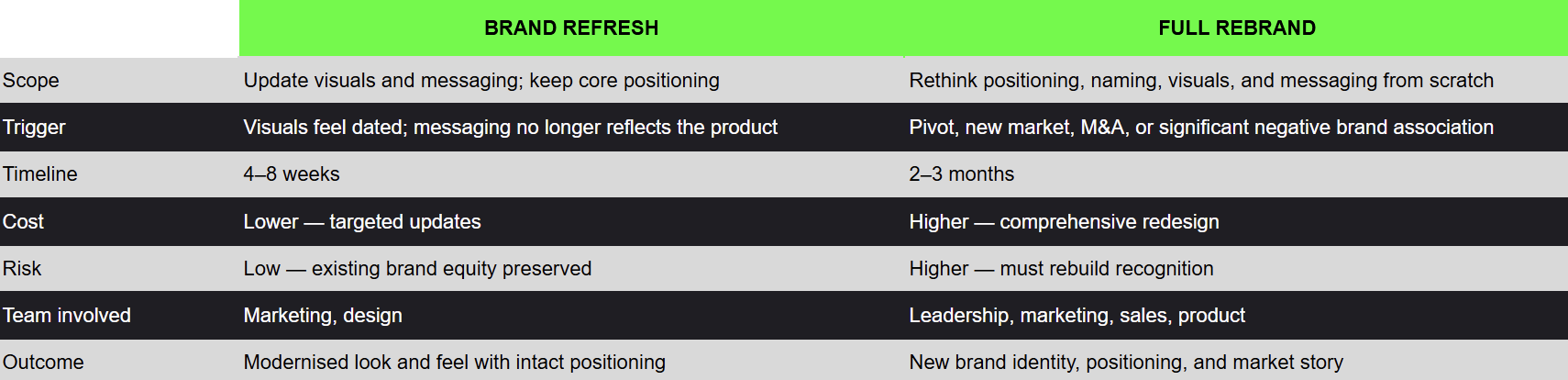
One of the most common questions in B2B SaaS brand strategy is knowing when to refresh your brand versus committing to a full rebrand. They’re very different projects — and the wrong choice wastes significant time and budget.
Signs You Need a Brand Refresh
- Your visuals look dated compared to competitors
- Your messaging no longer reflects what you actually do today
- Your target audience has shifted, but your brand hasn’t followed
- Customers describe you differently than you describe yourself
A refresh updates your visual identity and messaging while keeping your core positioning intact — lower risk, lower cost, faster to execute.
Signs You Need a Full B2B SaaS Rebrand
- You’ve pivoted your product or business model significantly
- You’re entering a completely new market or customer segment
- Your brand carries negative associations you need to move past
- A merger or acquisition has created a new entity that needs its own identity
A full rebrand involves rethinking your positioning, naming, visual identity, and messaging from the ground up. It’s a bigger investment — but when the trigger is real, it’s the right one.
Brand Refresh vs Rebrand: A Side-by-Side Comparison
Brand work can feel intangible, but its impact is measurable. Tracking the right metrics helps you understand whether your brand investments are generating returns and where to focus improvement efforts.
Brand Awareness and Recall
Awareness measures how many people know you exist. Recall shows whether they remember you unprompted when thinking about your category.
Track these through surveys, direct traffic trends in Google Analytics, and branded search volume in Google Search Console. For B2B SaaS, strong recall means prospects think of you first when they have a problem you solve.
Brand Preference and Consideration
Preference measures whether buyers choose you over competitors when given options. Track this through win/loss analysis, competitive deal reviews, and post-decision surveys asking prospects why they chose you — or didn’t.
Increased preference correlates directly with shorter sales cycles and higher win rates.
Brand Consistency Scores
Audit your brand presence across channels quarterly and score how consistently you’re applying your guidelines. Look for variations in logo usage, colour application, messaging tone, and visual style.
Higher consistency scores correlate with stronger brand recognition and buyer trust — particularly important in enterprise B2B, where multiple stakeholders evaluate your brand across different touchpoints before a decision is made.
Even well-resourced teams make branding mistakes that undermine their efforts. Here are the most common pitfalls in B2B SaaS brand strategy.
Skipping Strategy and Jumping to Design
Choosing colours and designing logos before defining your brand strategy leads to visuals that don’t support your positioning. Always start with research, audience definition, and messaging — then move to design. Strategy should drive design decisions, not the other way around.
Trying to Appeal to Everyone
Brands that try to please everyone usually excite no one. A generic, watered-down message may feel “safe,” but it’s not memorable. Strong brands stand for something specific, even if that positioning doesn’t resonate with everyone.
It’s better to deeply connect with a targeted audience than to be forgettable to a large one.
Neglecting Internal Alignment
Your brand isn’t just for customers — it’s for your team. If employees don’t understand and believe in your brand, they can’t communicate it effectively to buyers. Invest in internal brand training and make sure everyone — from sales to customer success to finance — knows your story.
Internal alignment creates external consistency.
Letting Brand and Sales Operate in Silos
Brand strategy that isn’t connected to sales pipeline goals is decoration. The most effective brand strategies in B2B SaaS are built with sales cycle length, deal velocity, and customer acquisition cost as primary inputs — not afterthoughts.
Building a clear brand identity for a growing B2B SaaS company isn’t a one-time project — it’s an ongoing investment that compounds as you scale.
Start with strategy: define your vision, mission, values, and positioning before touching design. Align your team through workshops and documented messaging frameworks. Build visual systems that are consistent across every touchpoint. And connect your brand work to sales and RevOps to ensure it generates real business results.
The companies that invest in brand clarity early enjoy shorter sales cycles, lower acquisition costs, and stronger customer loyalty. They stand out in the sea of sameness because they’ve done the work to define who they are — and communicate it with discipline and consistency.
If your brand hasn’t kept pace with your product, now is the time to close that gap.
Hunt + Hawk works with B2B SaaS founders and marketing leaders to close the brand-product gap. Our workshop-led process aligns your positioning, messaging, and visual identity with your sales and RevOps goals — so your brand works as hard as your product does. Get in touch to find out how.
FAQs About Brand Identity for B2B SaaS
What is brand identity for a B2B SaaS company?
Brand identity for a B2B SaaS company includes your visual elements (logo, colours, typography), your messaging, voice, positioning, and the emotional connection you create with buyers. It’s the complete picture of how your company shows up in the market — before, during, and after the sales process.
Why does brand identity matter for growing SaaS companies?
Brand identity matters because it shapes how prospects perceive you before speaking to your sales team. A clear brand reduces buyer uncertainty, shortens sales cycles, and helps you stand out from competitors with similar feature sets. It also reduces customer acquisition costs over time, as a recognisable brand generates more inbound interest.
How long does it take to build a brand identity?
The workshop-to-framework process typically takes 4–6 weeks depending on the complexity of your product and the number of markets or personas involved. A visual identity system built on top of that strategy adds a further 4–6 weeks. A full B2B SaaS rebrand — including positioning, naming, and visual redesign — typically runs 2–3 months end to end.
What is the difference between brand strategy and brand identity?
Brand strategy defines who you serve, what you stand for, and how you compete. Brand identity is the visual and verbal expression of that strategy. Both work together: strategy guides identity, and identity communicates strategy to the market.
How do I know if my B2B SaaS company needs a rebrand?
You likely need a rebrand if your visuals look dated compared to competitors, your messaging no longer reflects what you actually do, your target audience has significantly shifted, or your business has pivoted, merged, or acquired another entity. A brand refresh may be sufficient if the core positioning is still accurate but the expression has become stale.
What is the difference between a brand refresh and a full rebrand?
A brand refresh updates your visual identity and messaging while keeping your core positioning intact — lower cost, lower risk, and faster to execute. A full rebrand involves rethinking your positioning, naming, visual identity, and messaging from the ground up. It’s appropriate when your business model, market, or reputation has fundamentally changed.
How does brand clarity affect sales cycle length?
When prospects understand who you are and what you stand for before speaking to sales, discovery conversations move faster and qualification is cleaner. Based on Hunt + Hawk’s client data across 35+ B2B SaaS brands, companies that complete structured brand strategy work typically see a 20–30% reduction in sales cycle length within six months. Sales reps spend less time on basics and more time addressing specific buyer needs — which shortens the path to close and improves win rates.
What are messaging pillars in B2B SaaS brand strategy?
Messaging pillars are the three to five core themes your brand communicates consistently across all channels. Each pillar ties back to a specific customer need and supports your overall brand positioning. Examples for a B2B SaaS company might include “Quick Implementation,” “Enterprise-Grade Security,” and “Dedicated Customer Success.” Pillars give sales, marketing, and product teams a shared language to use with buyers.